


Common Forklift Types and Their Uses (Buyer’s Guide)
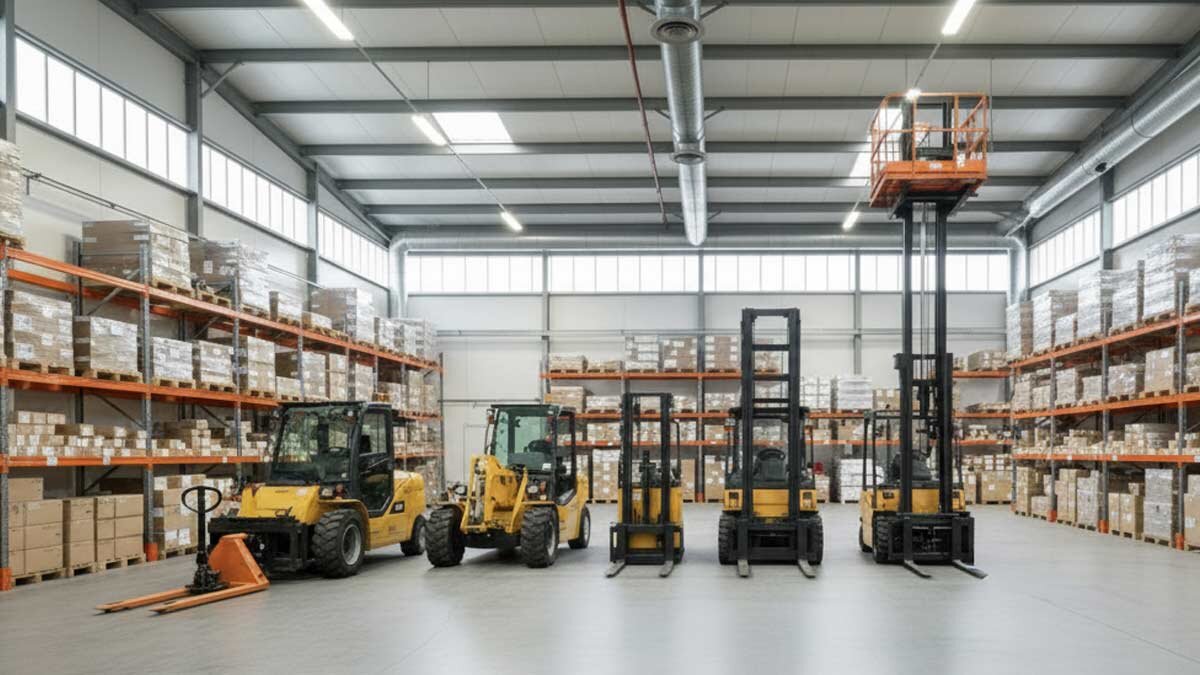
Running a small business means balancing efficiency, safety, and space. Whether you’re managing a warehouse, jobsite, or production floor, knowing the different types of forklifts and how they map into the OSHA forklift classes can help you match the right machine to your workflow. By the end of this article, you’ll feel confident discussing both the type of truck and the class it fits into, making your equipment decisions easier.
OSHA Forklift Classes: The Foundation
According to OSHA’s Powered Industrial Trucks (PIT) classifications, forklifts are grouped into classes I-VII as follows.
- Class I: Electric motor rider trucks—battery-powered, operator rides.
- Class II: Electric motor narrow aisle trucks—designed for confined spaces and often high-stack use.
- Class III: Electric motor hand trucks or hand/rider trucks—walk-behind or stand-on units.
- Class IV: Internal combustion engine trucks (solid/cushion tires)—IC engine, cushion tires, indoor smooth floor.
- Class V: Internal combustion engine trucks (pneumatic tires)—IC engine, pneumatic tires, outdoor/rougher surfaces.
- Class VI: Electric and internal combustion engine tractors—mostly towing applications.
- Class VII: Rough terrain forklift trucks—built for outdoor, uneven terrain.
Understanding which class your equipment falls into helps you align with OSHA training, certification, and safety compliance.
Why Using the Right Type of Forklift Matters
Different types of forklifts are built for different jobs. Factors like aisle width, load height, tire and fuel type, indoor vs. outdoor terrain—all of these affect which machine will serve you best. One version might be perfect in a wide-open warehouse; another will struggle in tight aisles or on rough ground. As you evaluate options, you’ll also want to think about forklift tire types and forklift fuel types (battery vs. internal combustion) since they influence cost, environment, and suitability.
Forklift Types
Forklift Type | Description | Ideal For | Typical Environment | Key Considerations |
Counterbalance Forklift | Classic lift truck design with front forks and a rear counterweight. | Everyday pallet handling, loading docks, and indoor storage. | Indoor or outdoor (smooth surface). | Needs space to turn; ideal for general warehouse tasks. |
Side Loader | Forks are mounted on the side for long, bulky loads. | Lumber, steel, or pipe handling in narrow aisles. | Indoor warehouses with long materials. | Great for narrow aisles but less versatile for standard pallets. |
Rough Terrain Forklift | Large pneumatic tires and higher clearance for uneven ground. | Construction, lumber yards, agriculture. | Outdoor / uneven terrain. | Not suited for indoor work; needs trained operators. |
Pallet Jack (Manual or Electric) | Compact lift for moving palletized loads over short distances. | Truck loading/unloading, tight aisles. | Indoor (smooth floors). | Minimal lift height; ideal for lightweight, quick jobs. |
Walkie Stacker | Walk-behind unit with powered lift for stacking higher than pallet jacks. | Moderate stacking in small warehouses. | Indoor only. | Limited reach and power; slower than ride-on forklifts. |
Order Picker Forklift | Operator platform lifts to reach individual items from shelves. | Picking orders in fulfillment centers. | Indoor warehouses. | Not for pallet transport; designed for item selection. |
Reach Fork Truck | Forks extend forward (“reach”) to access deep racks. | High-bay storage with narrow aisles. | Indoor (smooth floor). | Requires smooth surfaces; best for vertical stacking. |
Telescopic Handler (Telehandler) | Extendable boom and forks combine forklift and crane features. | Outdoor lifting at height, rough terrain. | Outdoor / construction sites. | Requires skill to operate; higher reach and cost. |
Stand-Up Forklift | Operator stands instead of sits for quick entry and exit. | Frequent loading tasks, narrow aisles. | Indoor warehouses. | Improves workflow in tight spaces; ergonomic comfort varies. |
Here’s a breakdown of key forklift types, what makes each unique, and where they shine. This includes both common and specialty types, so you’ve got a full view of what kinds of forklifts there are.
What Type of Forklift Is Best for Indoor Use?
If you’re mainly operating indoors, you’ll want to focus on equipment that falls into the electric (battery) categories and is designed for indoor flooring and aisle layouts.
- Class I (Electric motor rider trucks)—sit-down electric models.
- Class II (Electric motor narrow aisle trucks)—narrow aisle, high-stack indoor.
- Class III (Electric motor hand/rider trucks)—walk-behind or stand-on electrics.
Types of trucks that match these classes include electric forklifts, reach trucks, order pickers, walkie stackers, and stand-up forklifts. These are good picks for indoor use when you want to minimize emissions, noise, and space. That said, indoor doesn’t always mean one size fits all. A counterbalance forklift (Class I or IV depending on power source) might work indoors if your warehouse has wide aisles and smooth floors. The key is to match your facility, aisles, loads, and operations.
Additional Considerations: Tire Types, Fuel Types, and Comparisons
Forklift Tire Types
- Cushion tires: Solid rubber, smooth tread; best for indoor, smooth surfaces.
- Pneumatic tires: Air-filled or foam-filled with tread; designed for outdoor or uneven terrain.
Forklift Fuel Types
- Electric (Battery): Best for indoor use—quiet, no local emissions.
- Internal Combustion (Gas, Diesel, LPG): More power, suited for outdoor, well-ventilated spaces. Your choice of fuel (power source) often determines whether you fall into Class I/II/III (electric) or Class IV/V/VI (IC) categories.
Pallet Jack vs. Forklift
A pallet jack is a lighter item-handling tool suited for shorter distances and simpler tasks. A forklift gives you higher lift, more capacity, and more flexibility. When comparing pallet jacks and forklifts, think about load size, distance, stack height, and aisle width.
Telehandler vs. Forklift
A telehandler (telescopic handler) bridges the gap between a forklift and a crane: longer reach, higher lift, and often used outdoors. When looking at telehandlers and forklifts, you’re comparing long-reach, outdoor, flexible boom models with standard lift/truck-style machines.
Final Thoughts
Choosing the right forklift isn’t about finding “the best machine” in a generic sense. It’s about finding what fits your jobsite, your facility, and your workflow. By understanding the OSHA classes and the forklift types, you get a full picture. Whether you’re working at indoor warehouses or outdoor construction yards, you’ll feel confident in picking equipment that checks the boxes for safety, performance, and compliance.
Product Compliance and Suitability
The statements contained in this guide are intended for general informational purposes only. Such statements do not constitute a product recommendation or representation as to the appropriateness, accuracy, completeness, correctness, or currentness of the information provided. Information provided in this guide does not replace the use by you of any manufacturer instructions, technical product manual, or other professional resource or adviser available to you. Always read, understand, and follow all manufacturer instructions. Portions of this article were generated in part by ChatGPT, and edited by a member of the Zoro team.
