
Flange Size Chart
Flange size chart: ANSI 150/300 bolt circles and dimensions.
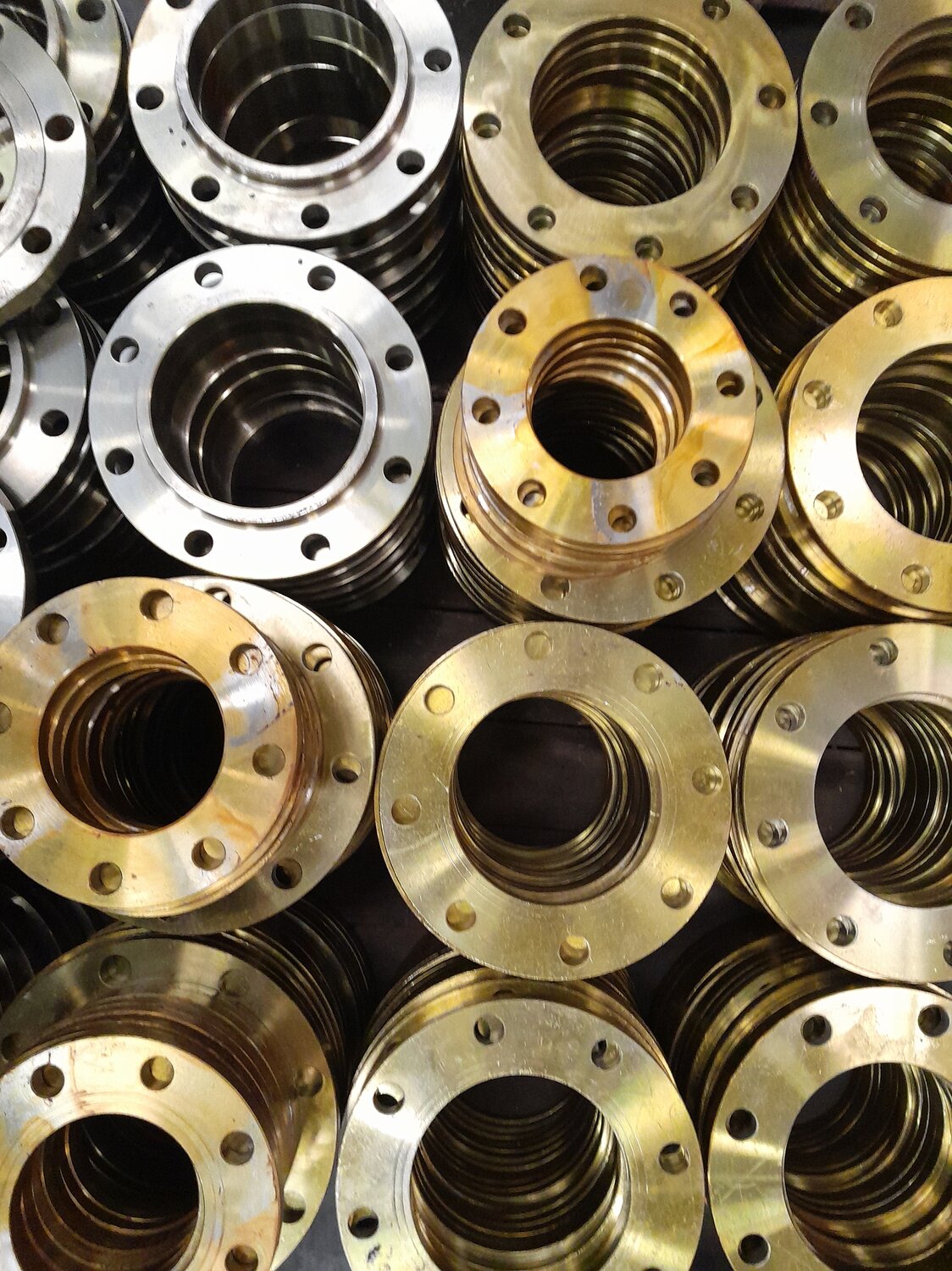
Flange Size Chart
A mismatched flange bolt pattern or face type creates a joint that cannot be assembled or sealed. ANSI/ASME B16.5 standardizes flange dimensions for pressure piping — but only if the class, nominal size, and facing match across both flanges in the connection. This flange size chart covers Class 150 and 300 flange dimensions from 1/2" through 12" for direct specification on piping drawings and purchase orders.
ANSI Flange Dimensions Chart
Dimensions per ASME B16.5 for Class 150 (same OD, bolt circle, and bolt count as Class 300 shown; thickness and bore vary by class and pipe schedule). Bolt holes are 1/16" larger than the listed bolt diameter. Both flanges in any connection must be the same class, facing, and nominal size.
| Nom. Pipe | Flange OD | Bolt Circle | # Bolts | Bolt Dia. | Hole Dia. | Classes |
|---|---|---|---|---|---|---|
| 1/2" | 3.50" | 2.38" | 4 | 1/2" | 5/8" | 150 / 300 |
| 3/4" | 3.88" | 2.75" | 4 | 1/2" | 5/8" | 150 / 300 |
| 1" | 4.25" | 3.12" | 4 | 1/2" | 5/8" | 150 / 300 |
| 1-1/4" | 4.62" | 3.50" | 4 | 1/2" | 5/8" | 150 / 300 |
| 1-1/2" | 5.00" | 3.88" | 4 | 1/2" | 5/8" | 150 / 300 |
| 2" | 6.00" | 4.75" | 4 | 5/8" | 3/4" | 150 / 300 |
| 2-1/2" | 7.00" | 5.50" | 4 | 5/8" | 3/4" | 150 / 300 |
| 3" | 7.50" | 6.00" | 4 | 5/8" | 3/4" | 150 / 300 |
| 4" | 9.00" | 7.50" | 8 | 5/8" | 3/4" | 150 / 300 |
| 6" | 11.00" | 9.50" | 8 | 3/4" | 7/8" | 150 / 300 |
| 8" | 13.50" | 11.75" | 8 | 3/4" | 7/8" | 150 / 300 |
| 10" | 16.00" | 14.25" | 12 | 7/8" | 1" | 150 / 300 |
| 12" | 19.00" | 17.00" | 12 | 7/8" | 1" | 150 / 300 |
ANSI Class 300 Flange Dimensions
| Nom. Pipe | Flange OD | Bolt Circle | # Bolts | Bolt Dia. | Flange Thk | Classes |
|---|---|---|---|---|---|---|
| 1/2" | 3.75" | 2.62" | 4 | 5/8" | 0.56" | 300 |
| 3/4" | 4.62" | 3.25" | 4 | 5/8" | 0.62" | 300 |
| 1" | 4.88" | 3.50" | 4 | 5/8" | 0.69" | 300 |
| 1-1/4" | 5.25" | 3.88" | 4 | 5/8" | 0.75" | 300 |
| 1-1/2" | 6.12" | 4.50" | 4 | 3/4" | 0.81" | 300 |
| 2" | 6.50" | 5.00" | 8 | 5/8" | 0.88" | 300 |
| 2-1/2" | 7.50" | 5.88" | 8 | 3/4" | 1.00" | 300 |
| 3" | 8.25" | 6.62" | 8 | 3/4" | 1.12" | 300 |
| 4" | 10.00" | 7.88" | 8 | 3/4" | 1.25" | 300 |
| 6" | 12.50" | 10.62" | 12 | 3/4" | 1.44" | 300 |
| 8" | 15.00" | 13.00" | 12 | 7/8" | 1.62" | 300 |
| 10" | 17.50" | 15.25" | 16 | 1" | 1.88" | 300 |
| 12" | 20.50" | 17.75" | 16 | 1-1/8" | 2.00" | 300 |
While it is a common misconception that Class 150 and Class 300 flanges are interchangeable, they are only compatible in very specific dimensions. As shown in the charts above, as the Pressure Class increases, the flange becomes significantly thicker and uses more (or larger) bolts to handle the increased mechanical stress. For example, a 2" Class 150 flange uses 4 bolts, whereas a 2" Class 300 flange requires 8 bolts. Never attempt to mate two different classes unless the specific bolt pattern and OD match exactly, and even then, the pressure rating of the entire joint will be limited to the lowest-rated component.
Flange Types
Slip-on (SO): Slips over the pipe end and is welded inside and outside. Easier to align than weld-neck. Less fatigue resistance — not recommended for cyclic or high-pressure service.
Weld-neck (WN): Full-penetration butt weld to the pipe. The highest-integrity flange joint. Required for high-pressure, cyclic, and cryogenic service.
Socket-weld (SW): For small-diameter, high-pressure service (typically 2" and below). The pipe inserts into the socket and is fillet-welded around the hub.
Threaded (THRD): Threaded to the pipe. No welding required. Used for low-pressure service and where welding is not permitted.
Blind (BL): Solid disk — no pipe opening. Used to close the end of a pipe or vessel nozzle.
Flange Pressure Classes
ASME B16.5 defines seven pressure classes: 150, 300, 600, 900, 1500, and 2500. The class number is not the working pressure in PSI — it is a designation from which the actual pressure rating is calculated based on material and temperature. A Class 150 carbon steel flange has a 285 PSI working pressure at ambient temperature; this drops significantly at elevated temperatures.
For standard industrial plant piping in mild service (water, air, steam below 150 PSI), Class 150 is the default. For higher-pressure or higher-temperature service, specify Class 300 or higher and consult ASME B16.5 Table 2 for the specific rating at operating temperature.
Flange Facing Types
- Raised Face (RF): The most common. A slightly raised seating surface that concentrates gasket load. Compatible with spiral-wound, ring-type joint, or flat sheet gaskets.
- Flat Face (FF): The seating surface is flush with the flange face. Used when connecting to cast iron or non-metallic flanges that cannot withstand the concentrated load of a raised face.
- Ring-Type Joint (RTJ): A machined groove that accepts a metal ring gasket. Used in high-pressure and high-temperature service where elastomeric gaskets are not suitable.
Gasket Selection for Flanged Connections
Gasket selection depends on the process fluid, temperature, pressure, and flange facing. Spiral-wound gaskets with a centering ring are the standard for Class 150 and above in steam, hot water, and general process service. Full-face flat gaskets are used with flat-face flanges connecting to cast iron equipment. Never mix gasket types or sizes from two different connection standards.
How to Measure a Flange for Identification
If you are in the field and need to identify an existing flange without a specification sheet, follow these three steps to match it to the chart:
- Count the Bolt Holes: This is the fastest way to narrow down the size. For example, if there are 4 holes, the pipe size is likely between 1" and 3". If there are 8, it is likely 4" to 8".
- Measure the Bolt Circle (BC): Do not measure the distance between adjacent holes. Instead, measure from the center of one hole to the center of the opposite hole across the bore.
- Measure the Bore (ID): For Slip-on or Socket-weld flanges, measure the inside diameter. For Weld-neck flanges, the bore will match the pipe's Schedule (e.g., Sch 40 or Sch 80).
Pro Tip: In the ANSI B16.5 standard, bolt holes are always drilled in multiples of four (4, 8, 12, 16, etc.) and are "straddled" across the vertical and horizontal centerlines unless otherwise specified.
Data Sources & Further Reading
- Standard: ASME B16.5-2020: Pipe Flanges and Flanged Fittings (NPS 1/2 through NPS 24).
- Technical Reference: Texas Flange Dimensional Resource Center.
- Piping Engineering Guide: Wermac Piping Reference Standards.
- Material Standards: ASTM A105 (Carbon Steel) and ASTM A182 (Stainless Steel).
Product Compliance and Suitability
The statements contained in this guide are intended for general informational purposes only. Such statements do not constitute a product recommendation or representation as to the appropriateness, accuracy, completeness, correctness, or currentness of the information provided. Information provided in this guide does not replace the use by you of any manufacturer instructions, technical product manual, or other professional resource or adviser available to you. Always read, understand, and follow all manufacturer instructions. Portions of this article were generated in part by ChatGPT.
