
Ground Wire Size Chart
Ground wire size chart per NEC 250: EGC and GEC sizing.
Ground Wire Size Chart
Undersized grounding conductors cannot safely carry the fault current required to trip a breaker — the result is prolonged arcing, equipment damage, and shock hazard. The NEC mandates minimum grounding conductor sizes in Article 250, Tables 250.66 and 250.122. This ground wire size chart summarizes those requirements for the most common circuit sizes in commercial and industrial wiring.
Ground Wire Sizing by Circuit Ampacity
The table below shows minimum equipment grounding conductor (EGC) size per NEC Table 250.122, grounding electrode conductor (GEC) size per NEC Table 250.66, and main bonding jumper size for the listed overcurrent protection device ratings. Copper conductors assumed throughout.
| OCPD Rating | Min. EGC (Cu) | Phase Conductor | Min. GEC (Cu) | Application |
|---|---|---|---|---|
| 15A | 14 AWG | 14 AWG | 14 AWG | Branch circuits, lighting, outlets |
| 20A | 12 AWG | 12 AWG | 12 AWG | Kitchen, bath, general purpose circuits |
| 30A | 10 AWG | 10 AWG | 10 AWG | Dryers, water heaters, A/C units |
| 40A | 10 AWG | 8 AWG | 10 AWG | Ranges, large HVAC, EV chargers |
| 60A | 10 AWG | 6 AWG | 10 AWG | Subpanels, large equipment feeders |
| 100A | 8 AWG | 4 AWG | 6 AWG | 100A subpanels, large equipment |
| 200A | 6 AWG | 2/0 AWG | 4 AWG | 200A service entrance, main feeders |
| 300A | 4 AWG | 350 kcmil | 2 AWG | Large commercial service |
| 400A | 3 AWG | 500 kcmil | 1 AWG | Very large commercial/industrial |
| 600A | 1 AWG | 2×350 kcmil | 2/0 AWG | Heavy industrial service |
OCPD = Overcurrent Protection Device. EGC = Equipment Grounding Conductor. GEC = Grounding Electrode Conductor. Values are for copper; aluminum requires two AWG sizes larger.
Equipment Grounding vs. Grounding Electrode Conductors
Equipment Grounding Conductor (EGC): Runs with the circuit conductors from the panel to the equipment. Its purpose is to provide a low-impedance return path for fault current so the overcurrent device trips quickly. Sized from NEC Table 250.122 based on the rating of the overcurrent device protecting the circuit.
Grounding Electrode Conductor (GEC): Connects the service equipment to the grounding electrode system (ground rods, metal water pipe, concrete-encased electrodes). Its purpose is to limit voltage on the system relative to earth. Sized from NEC Table 250.66 based on the size of the service entrance conductors.
These are two different conductors with different sizing requirements — do not confuse them or use the wrong table for sizing.
NEC 250 Grounding Requirements
- The EGC may be bare, covered, or insulated. If insulated, the insulation must be green or green with yellow stripes.
- The GEC must be continuous — no splices except by exothermic weld, listed irreversible splice connector, or listed clamp.
- Ground rods must be at least 8 feet long and 5/8" diameter (or 1/2" if listed for that use). Two ground rods are required unless the single rod measures 25 ohms or less.
- In a panel, the neutral-to-ground bond is made only at the service disconnect — never at a downstream subpanel.
Ground Wire Colors and Identification
- Bare copper: The most common EGC in conduit. No insulation required.
- Green insulated: Required when an EGC must be insulated (e.g., when run in a conduit with other conductors and must be identifiable).
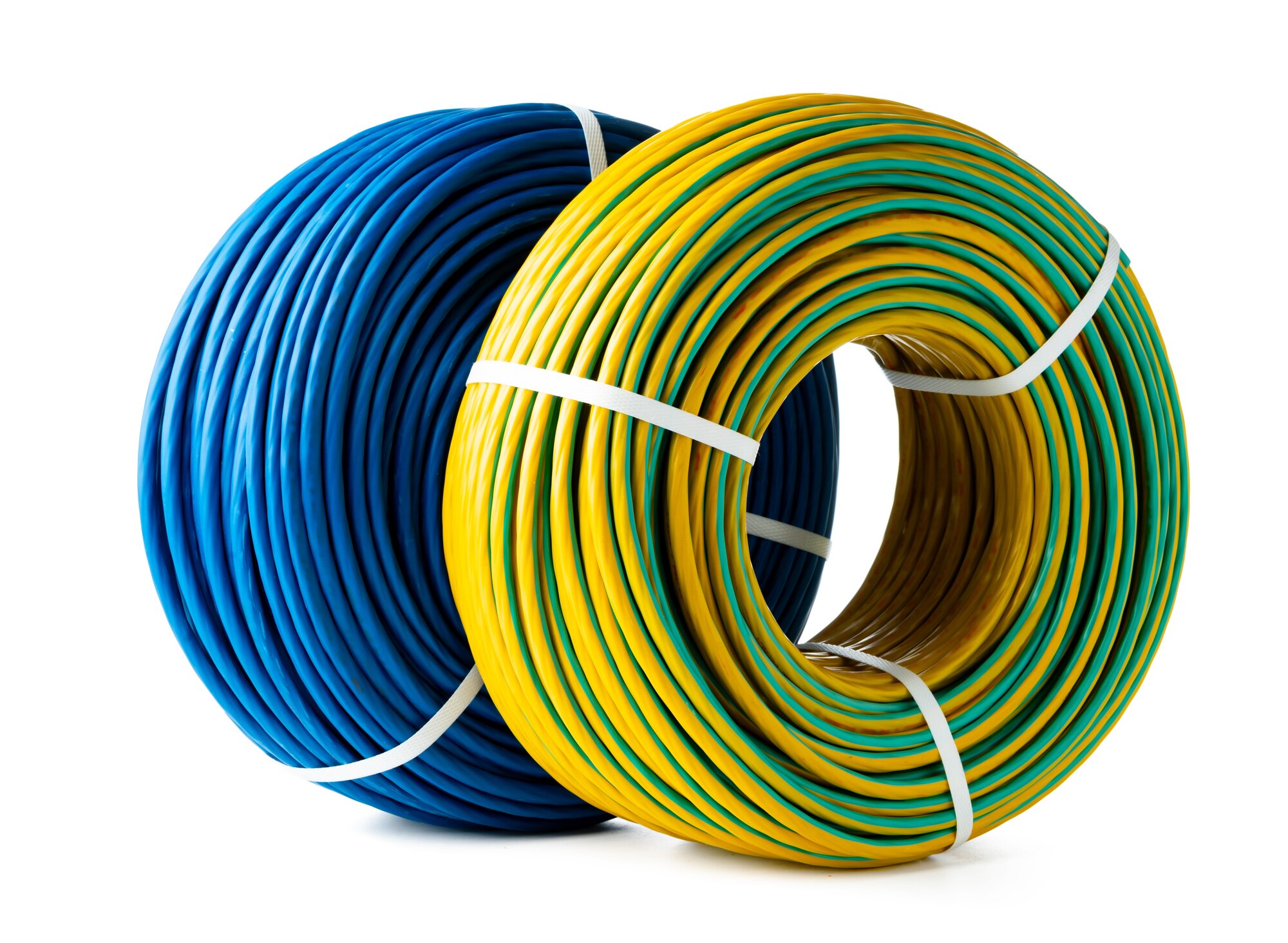
- Green with yellow stripe: Equipment grounding conductor per NEC — used as an alternative identification when green alone might be confused with other conductors.
- Gray or white: Neutral (grounded) conductor. Never use gray or white for an equipment grounding conductor.
Common Grounding Mistakes
Undersized EGC: Using the same size as the phase conductor without checking NEC 250.122. For large circuits, the EGC can be significantly smaller — but it must meet the table minimum.
Neutral-ground bond at subpanel: Bonding neutral to ground at a subpanel creates a parallel current path on the grounding conductor, which is a code violation and shock hazard.
Shared EGC: Using a single undersized EGC for multiple circuits without verifying it meets the size requirement for the largest OCPD in the group.
Product Compliance and Suitability
The statements contained in this guide are intended for general informational purposes only. Such statements do not constitute a product recommendation or representation as to the appropriateness, accuracy, completeness, correctness, or currentness of the information provided. Information provided in this guide does not replace the use by you of any manufacturer instructions, technical product manual, or other professional resource or adviser available to you. Always read, understand, and follow all manufacturer instructions. Portions of this article were generated in part by ChatGPT.
