


Forklift Dimensions Guide
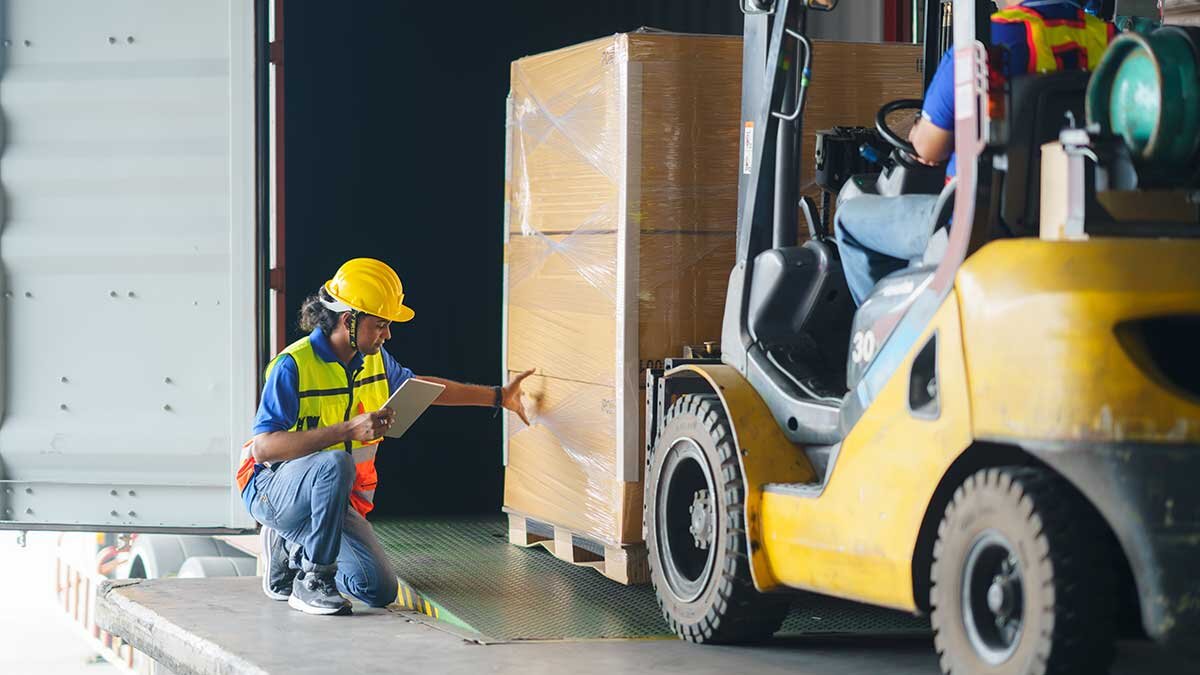
When you're evaluating equipment for your facility, one of the first questions to ask is, "What forklift size will fit my space and workload?" Forklift dimensions—width, height clearance, turning radius, and aisle width—directly impact how efficiently your team can move materials. Choosing the right size keeps your operations safe, efficient, and cost-effective.
Forklift Size Guide by Application
| Forklift Type | Width (Typical) | Length (Typical) | Height (Lowered) | Turning Radius | Aisle Width Needed | Common Use Case |
| Narrow Aisle Forklift | 36"–42" (3'–3.5') | 6'–8' | 6'–7' | 5'–6' | 8'–10' | High-density storage, tight warehouse aisles |
| Standard Warehouse Forklift | About 4' | 8'–10' | 7'–8' | 6'–7' | 12' | General pallet handling in warehouses |
| Rough Terrain Forklift | Up to 7' | 10'+ | 8'–10' | 8'–10' | 15'+ | Outdoor yards, uneven surfaces |
Understanding Forklift Height
The height of a forklift is determined by factors such as type (e.g., reach truck vs. counterbalance), mast design (two-stage vs. three-stage), and whether they're equipped with attachments like side shifters or fork positioners that could add extra height. The average forklift height ranges from 7' to 9' with the mast fully lowered, but this can vary significantly. While dimensions are fundamental, other specifications such as turning radius, weight capacity, and lifting height are equally important. These parameters deeply impact the forklift's utility and should be carefully considered.
How to Choose the Right Forklift Size
When selecting a forklift, business owners should evaluate three critical factors.
- Load Capacity—Standard warehouse forklifts typically handle between 3,000 lbs. and 5,000 lbs. Heavy-duty or rough terrain models are built for larger jobs and can exceed 15,000 lbs. Choosing a forklift with too much capacity can lead to unnecessary costs, while selecting one with too little capacity can create safety hazards and increase the risk of downtime.
- Facility Layout—Before purchasing a forklift, it’s important to measure aisle widths, doorway clearances, and racking heights to ensure the equipment will fit seamlessly into your facility. In some cases, narrow-aisle forklifts or reach trucks can help you maximize storage density without the need to expand your building footprint.
- Application Environment—Indoor facilities often benefit from electric forklifts because they run quietly and produce no emissions, making them well-suited for enclosed spaces. Outdoor yards, on the other hand, typically require forklifts equipped with pneumatic tires and higher ground clearance to safely handle uneven surfaces and rough terrain.
Buying Strategies for Business Owners
When planning your purchase, it’s important to:
- Future-proof your investment—Plan for anticipated growth in storage needs, not just today’s workload.
- Consider attachments—Side shifters, fork positioners, and clamps can add extra height and weight.
- Balance upfront cost vs. total ownership costs—Maintenance, fuel type, and operator training all affect long-term ROI.
Power Your Business with the Right Forklift Solutions
At Zoro, we make it simple to find what you need, whether that’s forklift attachments to handle specialized loads, warehouse safety gear to protect your team, or material handling equipment to keep products moving. With thousands of options in stock and no-hassle ordering, you can focus on running your business while we supply the tools and gear.
FAQs
What are the standard forklift dimensions?
Most standard forklifts are about 8'–10' long, 4' wide, and 7'–8' tall when lowered.
How much aisle width is needed for forklifts?
Standard forklifts need about 12' of aisle space, while narrow aisle models can operate in 8'–10'.
What is the typical forklift turning radius?
The average turning radius is 5'–7', depending on the forklift type.
How do I choose the right forklift size for my facility?
Consider load capacity, aisle width, ceiling height, and whether your operations are indoors or outdoors.
Product Compliance and Suitability
The statements contained in this guide are intended for general informational purposes only. Such statements do not constitute a product recommendation or representation as to the appropriateness, accuracy, completeness, correctness, or currentness of the information provided. Information provided in this guide does not replace the use by you of any manufacturer instructions, technical product manual, or other professional resource or adviser available to you. Always read, understand, and follow all manufacturer instructions. Portions of this article were generated in part by ChatGPT, and edited by a member of the Zoro team.
