


How Do Power Inverters Work?

At its most basic, a power inverter changes DC (direct current) power to AC (alternating current) power. This power conversion is often needed when running AC-powered electronics, like a portable video game or a GPS device, off the DC power that comes from the battery of a car, truck, or boat. It is also common with solar power, when the DC voltage from solar panels needs to connect with an AC power electric grid.
The Science Behind Inverters
Most cars and other vehicles get their power from 12-volt or heavier-duty 24-volt batteries that generate relatively low-voltage DC power with electricity that flows in a single direction. However, a large percentage of devices need more power than this DC power can realistically provide, as they are made to operate on 120-volt AC power, like the electricity coming out of your home’s outlets. AC power changes polarity, sending the current one way through the circuit, and then returning it back the other way. The electricity flows back and forth constantly, hence the name, “alternating current.”
An inverter is useful because it increases the DC voltage from a battery or solar panels, changes it to AC, and then sends the current to power your device or appliance. Here’s a bit of the science behind how it works.
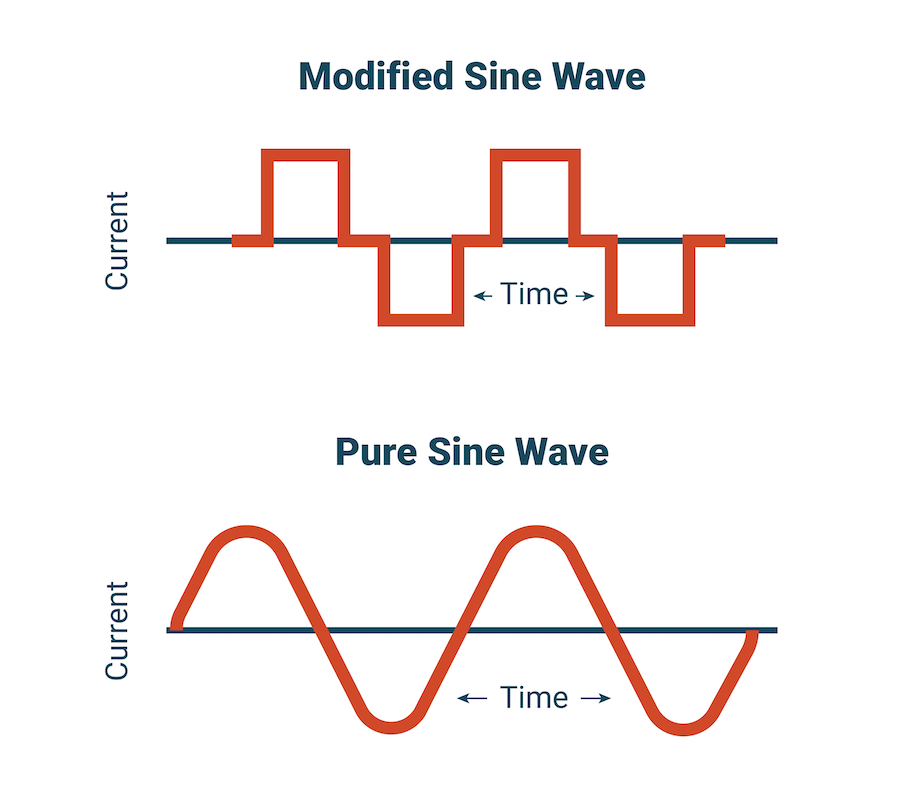
- Inside the inverter there are oscillators, circuits that produce repetitive electronic signals that rapidly reverse the polarity, or distribution of an electrical charge, of the DC current. This forms an alternating “modified sine wave” current, which is square shaped (see diagram).
- By modulating the frequency and duration of the distribution of these charges, the inverter can modify the square wave to more closely approximate the curved “pure sine wave” found in AC currents (see diagram).
- Finally, there is a transformer inside the inverter that boosts the voltage from the input voltage (usually 12- or 24-volt) to the output voltage (typically 120-volt)
Different types of devices perform better based on the quality of the power they receive. Extremely sensitive scientific or audio-visual equipment may even require a certain quality to operate at all. There are two primary types of inverters that are defined by the type of sine wave they produce.
Modified Sine Wave Inverters
Early-generation inverters worked by making the voltage go straight up and down, which generated the modified sine wave referenced above. This wave goes up and down like square-shaped building blocks. These inverters can power very simple systems that won’t suffer from choppy, interrupted currents, such as coffee makers, old TVs or low-power motors with brushes.
Modified sine wave inverters are electromagnetic devices that send current to either end of their internal circuits using a magnet and a wire attached to a spring arm. This “snap” of the wire to activate the current is what causes the buzzing sound often associated with these early inverters.
As mentioned, some equipment can’t be powered from modified sine wave inverters—and that list is growing longer by the day. Also, keep in mind that motors will run hotter and up to 30% less efficiently using modified sine wave inverters versus pure sine wave inverters.
Pure Sine Wave Inverters
Instead of wires and electromagnets, pure sine wave inverters utilize filters, inductors, and capacitors to smooth out the block-ish modified sine waves to more closely resemble smooth AC waves. Newer LED TVs and audio equipment will perform much better with this continuous power source. If you try to power these more advanced electronics with a modified sine wave inverter, they’ll likely flick on and off to a frustrating degree.
The main drawback of pure sine wave inverters is price, as they can be quite a bit more expensive than their modified wave counterparts. The cost of a modified sine inverter rated for 200-300 watts of power is typically $25 to $35, while the same power rating for a pure sine inverter can exceed $200.
How to Install
Most portable inverters are small enough to fit in a shirt pocket and are incredibly easy to install. This is especially the case with low-wattage models. Simply plug the cable into the cigarette lighter in your car and you’re good to go.
Higher wattage inverters (usually 400 watts and above) require a direct connection to the battery power source. These inverters feature input cables with clips that attach to the battery terminals in the same way you might attach jumper cables. When connecting an inverter directly to a battery, it is a good idea to put it somewhere with good airflow as it can generate a good amount of heat when in use. However, most inverters have a shut-off feature to stop them from overheating. Some newer inverters have other built-in safety features, including an alarm that sounds when the battery voltage dips under a certain threshold.
Inverters are convenient solutions for when you need reliable power on the go. The best way to determine which inverter will work for your needs is to consider the type of equipment you are looking to power, and to estimate the wattage of those devices or appliances.
Product Compliance and Suitability
The product statements contained in this guide are intended for general informational purposes only. Such product statements do not constitute a product recommendation or representation as to the appropriateness, accuracy, completeness, correctness or currentness of the information provided. Information provided in this guide does not replace the use by you of any manufacturer instructions, technical product manual, or other professional resource or adviser available to you. Always read, understand and follow all manufacturer instructions.
