
Hydraulic Press Tonnage Guide
Estimate press tonnage needs based on workpiece material and key shop tasks.
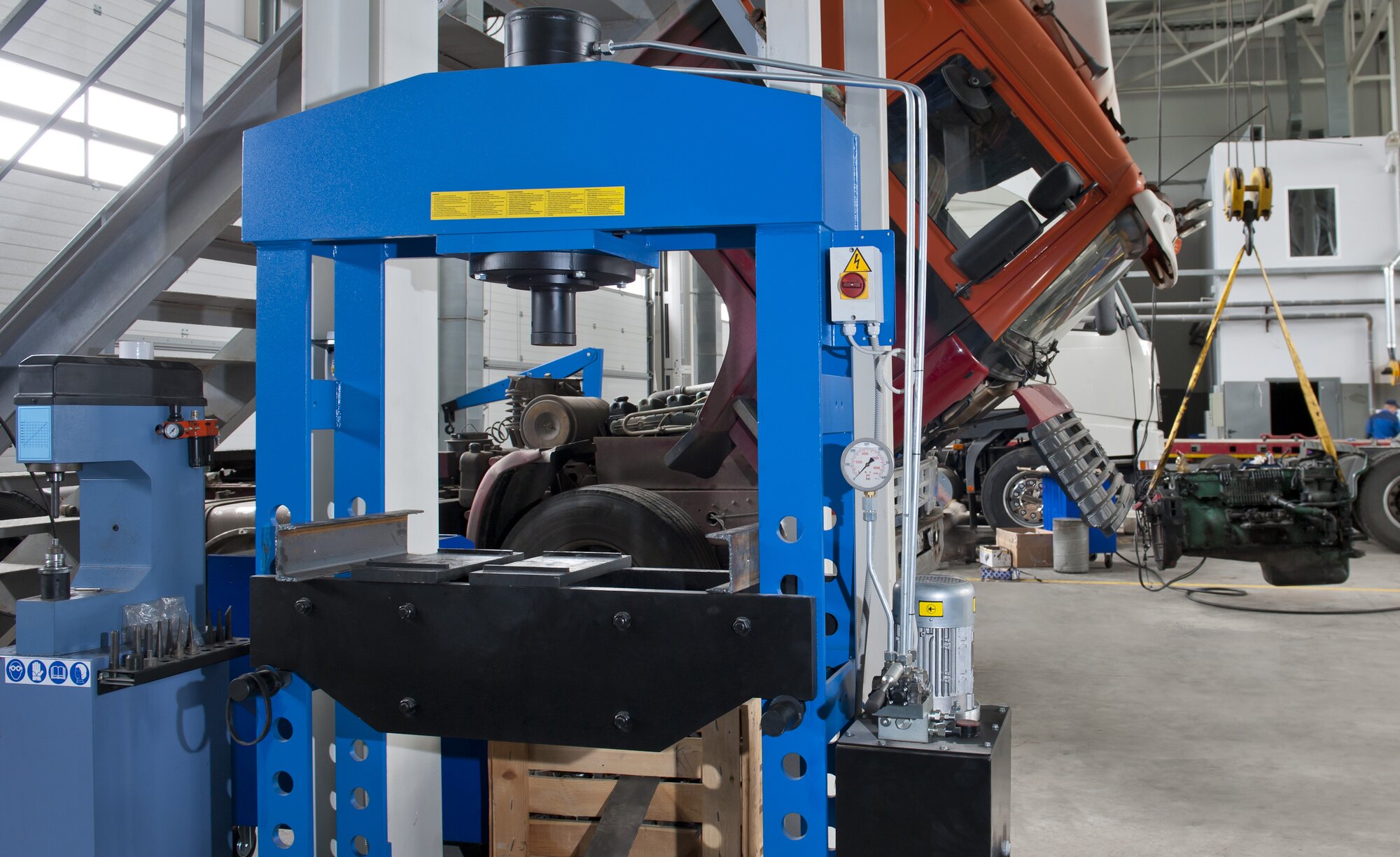
Choosing the right hydraulic press starts with understanding the force required for your work. A press that does not provide enough capacity may be unsuitable for the application, while selecting a machine based on tonnage alone can overlook important factors such as workpiece size, frame clearance, and operating requirements.
A shop press is commonly used for tasks such as installing or removing bearings, pressing bushings, straightening compatible components, and performing maintenance work. The appropriate hydraulic press depends on the materials being worked, the operation being performed, and the dimensions of the parts.
This guide explains hydraulic press tonnage, how to evaluate capacity, and what to consider when selecting a shop press for a maintenance shop, automotive facility, or industrial workspace.
What Is Hydraulic Press Tonnage?
Hydraulic press tonnage describes the force a press is designed to apply. Manufacturers commonly express press capacity in tons, although the exact rating and specifications depend on the equipment.
Hydraulic presses use pressurized fluid to move a cylinder and generate force. The machine's rated capacity indicates its specified force capability under the manufacturer's stated conditions.
When comparing presses, verify whether the capacity is listed in U.S. short tons, metric tonnes, or another unit. These measurements are not identical, so use consistent units when evaluating equipment.
How Much Tonnage Does a Shop Press Need?
The required press capacity depends on the work being performed. Removing a bearing, installing a bushing, straightening a component, and forming material can require different amounts of force.
There is no single tonnage rating that is appropriate for every shop. Use the application, workpiece specifications, tooling requirements, and manufacturer's guidance to determine the required capacity.
| Selection Consideration | Questions to Ask |
|---|---|
| Application | Will the press be used for bearing removal, bushing installation, straightening, forming, or another task? |
| Required force | Is the required force known from the component specifications, process documentation, or tooling guidance? |
| Workpiece dimensions | Will the part fit within the press frame and working area? |
| Tooling | Are the press plates, adapters, and accessories suitable for the workpiece and operation? |
| Operating frequency | Will the press be used occasionally or as part of a recurring maintenance or production process? |
| Future applications | Will the machine need to accommodate other approved tasks in the future? |
When the force requirement is uncertain, consult the component or tooling manufacturer or a qualified technical specialist. Do not select a press based only on the assumption that a larger capacity is always appropriate.
Understanding Common Shop Press Capacity Ratings
Shop presses are sold in a range of capacity ratings. The best choice depends on the intended application and the machine's other specifications.
The following table provides a framework for comparing capacity options. These are general selection categories, not universal application ratings or recommendations for a particular job.
| Capacity Category | What to Evaluate | Best Selection Approach |
|---|---|---|
| Lower-capacity shop presses | Smaller components, available working space, and the force required for routine tasks | Confirm that the rated capacity meets the actual force requirement and that the workpiece fits. |
| Mid-range shop presses | Variety of maintenance tasks, component dimensions, and expected workload | Compare rated force, frame clearance, bed adjustment, and compatible tooling. |
| Higher-capacity shop presses | Greater force requirements, larger workpieces, and installation demands | Verify the application requirements, equipment rating, foundation or mounting needs, and operating procedures. |
Always use the manufacturer's actual capacity specifications when comparing models. A capacity category by itself does not establish that a press is suitable for a specific part or task.
How to Calculate Hydraulic Press Force
For a hydraulic cylinder, theoretical force can be estimated from hydraulic pressure and the effective piston area.
Force = Pressure × Piston Area
When pressure is expressed in pounds per square inch (PSI) and piston area is expressed in square inches, the result is pounds of force.
For a circular piston, the area can be calculated using:
Piston Area = π × (Piston Diameter ÷ 2)2
To convert pounds of force to U.S. short tons, divide the force in pounds by 2,000.
For example, a theoretical calculation using a pressure of 2,000 PSI and a piston area of 10 square inches gives:
- Force = 2,000 PSI × 10 square inches
- Theoretical force = 20,000 pounds
- Equivalent force = 10 U.S. short tons
This simplified calculation does not account for all real-world system limitations, including pressure losses, mechanical design, cylinder specifications, or the press's rated capacity. It should not be used to override manufacturer ratings or operating limits.
Hydraulic Press Capacity vs. Workpiece Size
Tonnage is only one part of press selection. The machine must also accommodate the dimensions and shape of the part being worked.
Working Width
Working width determines the available space across the press frame. Check the dimensions of the largest workpiece you expect to process, including any fixtures or tooling that must fit alongside it.
Working Height and Bed Opening
The distance between the ram and the work surface affects how tall a workpiece can be positioned in the press. An adjustable bed may provide additional flexibility, but the available working height depends on the specific model and setup.
Ram Travel
Ram travel describes how far the press ram can move. Confirm that the available travel is appropriate for the work and tooling without exceeding the machine's specified operating range.
Frame and Bed Design
The frame and bed support the press's working arrangement. Check the manufacturer's instructions for workpiece placement, supported loading positions, bed adjustment, and any restrictions on off-center loads.
Manual, Pneumatic, and Electric Hydraulic Shop Presses
Shop presses can use different methods to actuate the hydraulic system. The appropriate arrangement depends on the available utilities, desired control, workload, and equipment specifications.
| Press Configuration | General Considerations | What to Verify |
|---|---|---|
| Manual hydraulic press | Manual pump operation and a relatively straightforward utility setup | Required operator effort, rated capacity, operating controls, and application suitability |
| Air-powered hydraulic press | Uses a compatible compressed-air supply to actuate the hydraulic system | Required air pressure and flow, utility availability, and manufacturer specifications |
| Electric-powered hydraulic press | Uses an electric power source to operate the hydraulic system | Electrical requirements, controls, operating cycle, maintenance needs, and rated performance |
Product configurations and terminology vary by manufacturer. Confirm the actuation method and utility requirements for the specific press you are considering.
Hydraulic Press Safety and Operating Considerations
Hydraulic presses can apply substantial force. Improper workpiece positioning, unsuitable tooling, or operation beyond the equipment's limits can create serious hazards.
- Read and follow the manufacturer's operating instructions.
- Confirm that the press, tooling, and accessories are rated for the intended application.
- Position and support the workpiece according to the manufacturer's procedures.
- Keep hands and other body parts away from pinch and crush points.
- Use required guarding and protective equipment.
- Do not exceed the press's rated capacity or use damaged equipment.
- Do not stand in line with components that could shift or eject under force.
- Inspect the press and accessories according to the required maintenance schedule.
Never improvise adapters or supports that are not suitable for the load. If the correct setup or required force is uncertain, stop and consult qualified technical personnel before proceeding.
Hydraulic Shop Press Buying Checklist
- Application: Have you identified the operations the press must perform?
- Capacity: Is the rated tonnage appropriate for the documented force requirements?
- Workpiece size: Are the working width, height, and bed opening sufficient?
- Ram travel: Is the available travel suitable for the intended task?
- Actuation: Does the press's manual, pneumatic, or electric configuration fit your operation?
- Utilities: Are the required electrical or compressed-air connections available?
- Tooling: Are compatible press plates and accessories available?
- Safety: Have operating instructions, guarding, and training requirements been reviewed?
- Maintenance: Are inspection, service, and replacement-part requirements understood?
Frequently Asked Questions
What does tonnage mean on a shop press?
Tonnage describes the press's rated force capacity. Confirm the unit of measurement and the manufacturer's rating before comparing presses or selecting equipment for an application.
How do I know what size hydraulic press I need?
Start with the work you intend to perform and identify the required force, workpiece dimensions, tooling, and operating conditions. Compare those requirements with the manufacturer's capacity rating and dimensional specifications.
Is a higher-tonnage shop press always better?
No. A higher capacity may be unnecessary for some applications, and tonnage alone does not determine whether a press will fit the workpiece or provide the required working clearance. Select equipment based on the complete application requirements.
What is the difference between a shop press and a hydraulic press?
A shop press is a type of press commonly used for maintenance, repair, and workshop tasks. Hydraulic describes the method used to generate force. Hydraulic presses are available in a variety of configurations for different applications.
Product Compliance and Suitability
The statements contained in this guide are intended for general informational purposes only. Such statements do not constitute a product recommendation or representation as to the appropriateness, accuracy, completeness, correctness, or currentness of the information provided. Information provided in this guide does not replace the use by you of any manufacturer instructions, technical product manual, or other professional resource or adviser available to you. Always read, understand, and follow all manufacturer instructions. Portions of this article were generated in part by ChatGPT.
