


Industrial Router Bits Guide: Types, Profiles, and Maintenance Tips for Pros
The Basics Every Shop Owner Should Know
If you’re running a construction, manufacturing, or millwork shop, the router bit is one of your most versatile tools. But the real precision comes from the bit you choose. This guide covers everything you need to know about router bits—types, profiles, speeds, and sharpening—so your team can get clean, consistent results with every cut.
Understanding Router Bit Basics
Every router bit has three main parts.
Shank: The part that fits into your router (usually ¼" or ½").
Flutes: The cutting edges that remove material.
Bearing: A guide wheel used for trimming and edge-forming tasks.
Carbide-tipped bits last longer under heavy industrial use, while high-speed steel (HSS) offers affordability for lighter work. If your shop uses larger routers or CNCs, ½" shank bits help reduce vibration and extend tool life.
Types of Router Bits and Their Uses
Straight Bits
These are your go-to for grooves, dados, and plunge cuts. If you need to remove material or create inlays, a straight or spiral bit will serve you well.
Edge-Forming Bits
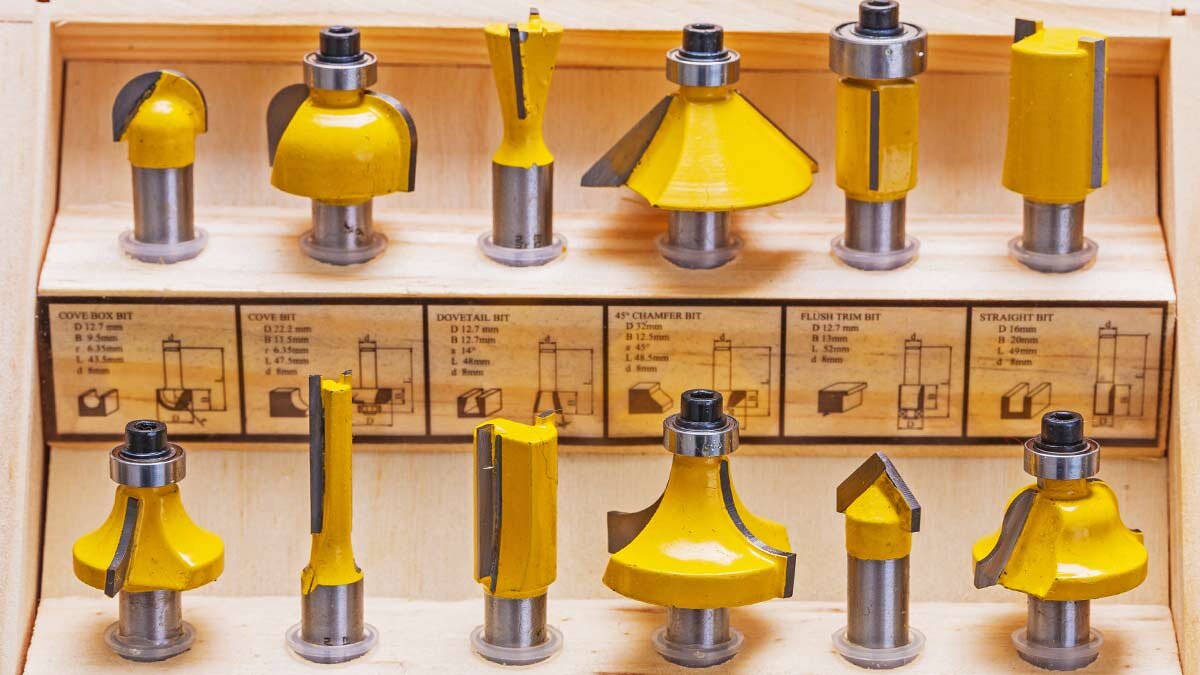
This group adds the finished profile to your workpiece. Roundover bits soften corners. Cove bits add concave profiles. Chamfer bits cut angled edges. Ogee or beading bits bring decorative trim. These are essential when you’re building high-quality cabinetry and fixtures or in architectural millwork.
Flush Trim and Template Bits
These bits feature a pilot bearing to follow a template or trim laminated surfaces flush with a substrate. Ideal in a production environment where you’re copying parts or need consistency across multiple pieces.
Joinery and Specialty Bits
For structural or detailed work, consider bits designed for rabbets, tongue-and-groove, raised panels, or sign making. These allow your router to handle joinery tasks and more complex profiles beyond just trimming and edge shaping.
Router Bit Profiles Explained
A bit’s profile determines the shape it leaves behind. It’s really the “signature” of the bit in your material.
Straight or square profiles: used for dados, rabbets, grooves.
Decorative profiles: roundover, cove, ogee, beading, etc.—used where the edge will be visible.
Keeping a labeled sample strip or gauge of your most used profiles can help your team select the right bit quickly and maintain consistency across production runs.
Router Bit Speeds and Feeds
Speed settings and feed rate matter for cut quality, tool life, and safety.
Smaller diameter bits can run at higher RPM.
Larger bits need slower speeds to maintain control and avoid burning.
Always maintain a steady feed rate: too slow and you may burn the workpiece; too fast and you risk chatter or tear-out.
Posting a handy speed-and-feed chart near your routers improves consistency and reduces mistakes.
How to Choose Router Bits for Your Shop
When you’re selecting bits, consider these factors.
Material type (wood, laminate, composite) and bit material (HSS vs. carbide).
Cut quality: Do you need a smooth finish or rough shaping?
Machine compatibility: Are you using a handheld router, router table, or CNC router?
Budget vs. quality: A high-quality bit might cost more up-front but save you downtime and yield better results.
In an industrial or manufacturing environment, invest in a core set of bits that cover your most common tasks: e.g., one straight bit, one round-over bit, one chamfer, one flush trim. Then expand only as new jobs require new profiles.
How to Sharpen Router Bits
Keeping bits sharp matters for productivity, quality, and safety.
Remove resin or pitch buildup before sharpening.
Use a diamond hone to touch up carbide edges lightly.
For complex or high-value bits, send them to a professional sharpening service to restore geometry. Track bit life by marking sharpening dates or number of uses. A dull bit slows you down, creates tear-out, and increases stress on the router.
Putting It All Together
Organizing your router bits by type, labeling profiles, and maintaining a sharpening schedule helps your shop stay efficient and productive. The right bit doesn’t just cut. It shapes the quality and consistency of your work.
Product Compliance and Suitability
The statements contained in this guide are intended for general informational purposes only. Such statements do not constitute a product recommendation or representation as to the appropriateness, accuracy, completeness, correctness, or currentness of the information provided. Information provided in this guide does not replace the use by you of any manufacturer instructions, technical product manual, or other professional resource or adviser available to you. Always read, understand, and follow all manufacturer instructions. Portions of this article were generated in part by ChatGPT, and edited by a member of the Zoro team.
