
O-Ring Size Chart
O ring size chart: AS568 dash numbers with ID and cross-section.
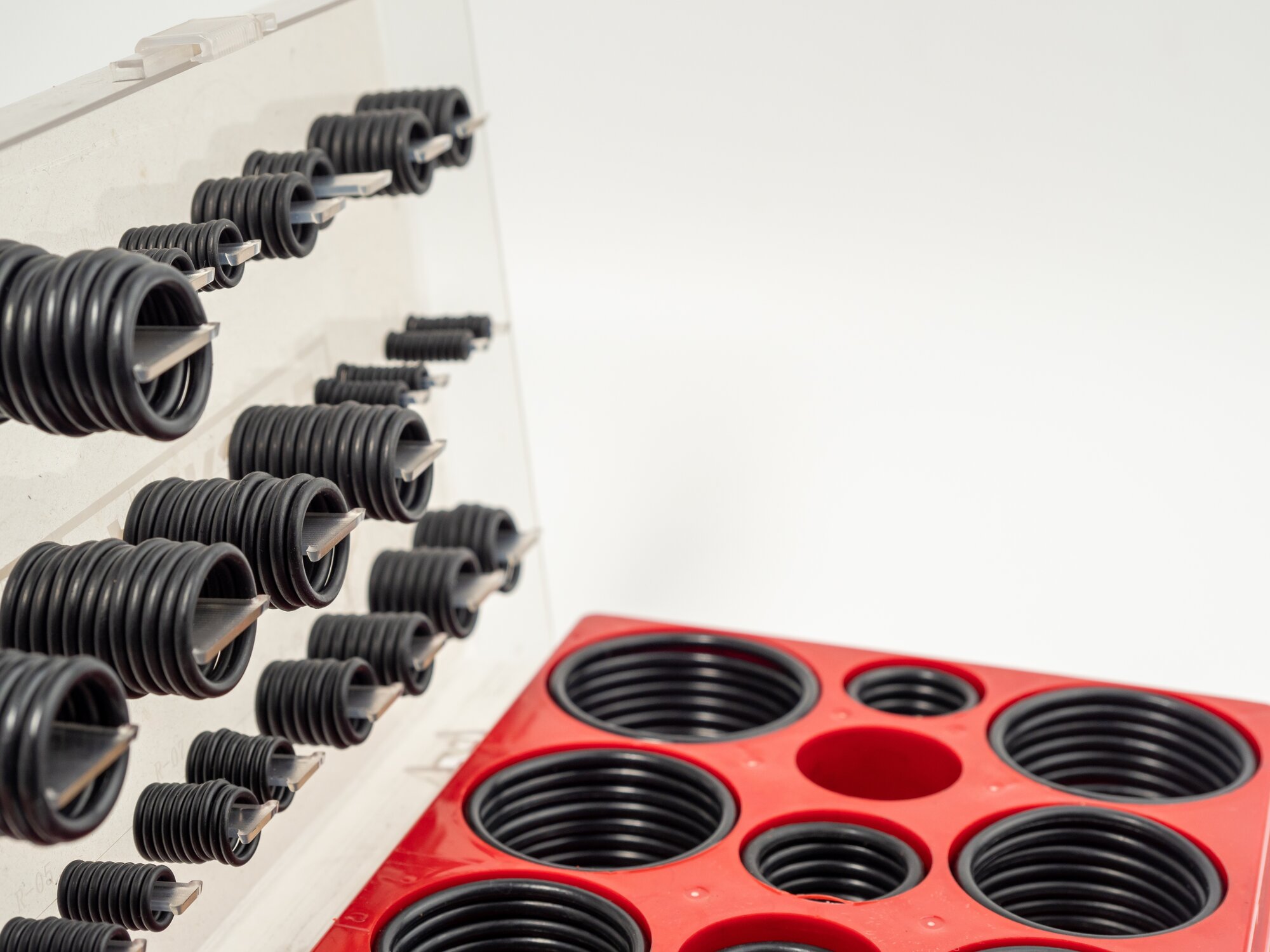
O Ring Size Chart
A wrong-size O-ring either extrudes under pressure or leaks from a loose fit — both cause failure and downtime. The AS568A standard (published by SAE) defines the standard O-ring dash sizes used across North American hydraulic, pneumatic, and industrial systems. This O ring size chart covers the most commonly stocked AS568 dash numbers with inside diameter, cross-section diameter, and the applications where each size is typically found.
AS568 O-Ring Sizes and Dimensions
Dimensions are nominal per AS568A. Actual dimensions have tolerances that vary by dash number range — consult the full AS568A standard for precise tolerance specifications for critical sealing applications.
| Dash No. | Inside Dia. (in) | Cross-Section (in) | Cross-Section (frac) | Common Application |
|---|---|---|---|---|
| 002 | 0.064" | 0.040" | 1/16" | Light instrument fittings, small valves |
| 006 | 0.114" | 0.040" | 1/16" | Small hydraulic ports, sensors |
| 010 | 0.239" | 0.040" | 1/16" | Hydraulic fittings, small cylinders |
| 012 | 0.301" | 0.040" | 1/16" | Standard small hydraulic fittings |
| 016 | 0.426" | 0.070" | 5/64" | Medium hydraulic fittings, valve bodies |
| 110 | 0.489" | 0.070" | 5/64" | General hydraulic, pneumatic ports |
| 113 | 0.612" | 0.070" | 5/64" | Common valve and cylinder applications |
| 116 | 0.799" | 0.070" | 5/64" | Pipe plug seals, hydraulic adapters |
| 214 | 0.864" | 0.139" | 1/8" | High-pressure hydraulic fittings |
| 216 | 0.989" | 0.139" | 1/8" | Standard hydraulic cylinder rod seals |
| 218 | 1.114" | 0.139" | 1/8" | Medium cylinders, valve seals |
| 222 | 1.364" | 0.139" | 1/8" | Large hydraulic cylinders, pipe seals |
| 226 | 1.614" | 0.139" | 1/8" | Large bore cylinders, manifold seals |
| 332 | 2.106" | 0.210" | 3/16" | Large hydraulic cylinders, pump seals |
| 340 | 2.606" | 0.210" | 3/16" | Very large cylinders, compressor seals |
| 348 | 3.106" | 0.210" | 3/16" | Very large industrial seals |
How O-Ring Dash Numbers Work
AS568A dash numbers are grouped by cross-section diameter: -0xx series (0.040" cross-section), -1xx series (0.070" cross-section), -2xx series (0.139" cross-section), -3xx series (0.210" cross-section), and -4xx series (0.275" cross-section). Within each series, the last two digits correspond to ID steps. Once you know the cross-section needed for your groove depth and the ID from the groove bore, you can identify the dash number from the chart.
O-Ring Material Selection
- Nitrile (Buna-N / NBR): The general-purpose default. Excellent resistance to petroleum oils, hydraulic fluid, and fuels. Temperature range: -40°F to 250°F. Not suitable for brake fluid, phosphate ester hydraulic fluids, or ozone exposure.
- Viton (FKM): High-temperature and chemical resistance. Rated to 400°F continuous. Compatible with most oils, solvents, and fuels, including phosphate ester and synthetic hydraulic fluids. Higher cost than Nitrile.
- EPDM: Excellent for water, steam (up to 250°F), and brake fluid. Not compatible with petroleum oils — never use EPDM in a hydraulic system.
- Silicone (VMQ): Wide temperature range (-60°F to 400°F). Good for dry heat and ozone. Poor mechanical strength and tear resistance — not suitable for dynamic sealing applications.
- PTFE (Teflon): Chemical-resistant, low friction. Used as backup rings and in aggressive chemical service. Not elastic — PTFE O-rings require energizer springs or spring-loaded designs.
O-Ring Groove Design
O-ring sealing performance depends on proper groove dimensions. The groove must compress the O-ring 10–30% in the radial direction (squeeze) while allowing it to expand axially into the groove. ASTM and SAE standards publish groove design recommendations for each cross-section. A groove that is too shallow causes extrusion; one that is too deep allows the O-ring to roll and leak.
How to Measure an O-Ring
Measure the inside diameter (ID) with a calibrated ID measuring tool or ruler across the inside of the ring. Measure the cross-section (CS) with calipers across the thickness of the ring body. Both measurements should be taken on a relaxed, unstretched ring. Match these two measurements to the AS568 chart to identify the dash number and source an exact replacement.
Product Compliance and Suitability
The statements contained in this guide are intended for general informational purposes only. Such statements do not constitute a product recommendation or representation as to the appropriateness, accuracy, completeness, correctness, or currentness of the information provided. Information provided in this guide does not replace the use by you of any manufacturer instructions, technical product manual, or other professional resource or adviser available to you. Always read, understand, and follow all manufacturer instructions. Portions of this article were generated in part by ChatGPT.
