


How to Choose the Right Pressure Gauge
Don't let the pressure get to you - a comprehensive guide on choosing the right pressure gauge for your needs.
1/27/20 - Zoro Staff
Choosing the correct pressure gauge for an application can cause confusion. With all the different types, accuracies, scales, and connection sizes, how do you select one and what do they all mean? The following guide will seek to explain these different aspects, and assist in making the correct selection for your application.
Accuracy
The accuracy of gauges can be expressed in a couple different ways. Full range gauges will have a single number that represents the accuracy across the entire span of the gauge; for example +/- 1%. This means that no matter what your reading is, the measurement is within + or - 1% of the gauge’s range. Imagine you have a gauge with a range of 0-100 psi, and the needle is reading 50 psi. With a +/- 1% accuracy gauge, the actual pressure can be between 49 and 51 psi.
Other types of gauges will have their accuracy expressed in a series of three numbers, like +/- 2-1-2 % or +/- 3-2-3 %. For this type of gauge, the accuracy will depend on where the needle is within the span of the gauge. In the case of a +/- 3-2-3 %, the first 1/4 of the range will have an accuracy of +/-3%, the middle 1/2 of the range will improve to +/-2%, and the last 1/4 of the range will be back to +/-3% accuracy.
For applications requiring greater accuracy, a full range accuracy gauge is the gauge of choice. In addition, particularly in the case of gauges with varying accuracy, choosing a gauge with twice the range of your target pressure will be beneficial for both accuracy and safety.
Types
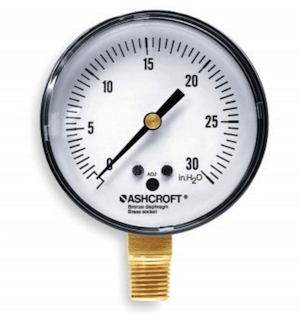
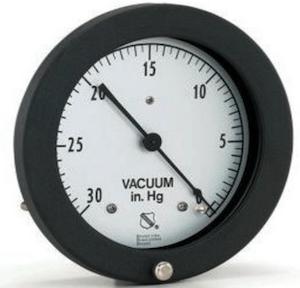
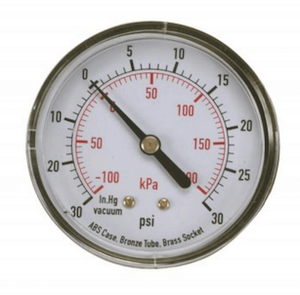
At the most basic level, gauges can be divided into three different types; Pressure, Vacuum, and Compound.
Pressure Gauges are designed to read positive pressure in an application.
Vacuum Gauges are used to read negative pressure (vacuum).
Compound Gauges are used to read pressure or vacuum in an application.
Connections
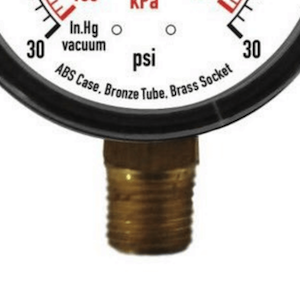
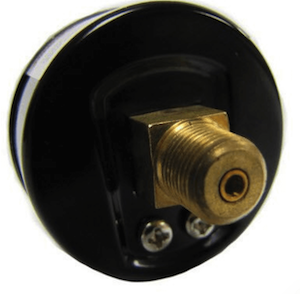
Two things to consider when selecting a gauge are the size of the connection and its location. The location of the connection on most standard gauges is either at the bottom of the gauge, or the center back of the gauge. Selection should be based on the position which makes it most easy to read or access the gauge. The most common connection thread size is usually 1/4” NPT (National Pipe Thread) or in some cases 1/2” NPT. However, there can be exceptions to this, such as in the case of metric or left handed threads for OEM applications.
|
Bottom Mount |
Back Mount |
| ASME Class | Accuracy |
|---|---|
| Grade A | +/-2-1-2% of span |
| Grade B | +/-3-2-3% of span |
| Grade 1A | +/- 1% of span |
| Grade 2A | +/- 0.5% of span |
| Grade 3A | +/-0.25% of span |
Please note, only gauges cleaned and rated for such service should be used with oxygen. If not cleaned properly for oxygen use, a severe reaction can occur.
Common Scales
| PSI | Pounds per Square Inch |
| in. Hg. ("Hg) | Inches of Mercury |
| in. H2O ("H2O) | Inches of Water Column |
| kPa | kilopascal |
| mBar | millibar |
| Oz/sq. in. | Ounces per Square Inch |
Product Compliance and Suitability
The product statements contained in this guide are intended for general informational purposes only. Such product statements do not constitute a product recommendation or representation as to the appropriateness, accuracy, completeness, correctness or currentness of the information provided. Information provided in this guide does not replace the use by you of any manufacturer instructions, technical product manual, or other professional resource or adviser available to you. Always read, understand and follow all manufacturer instructions.
