


Torx Bit Sizes: Your Go-To Chart and Guide
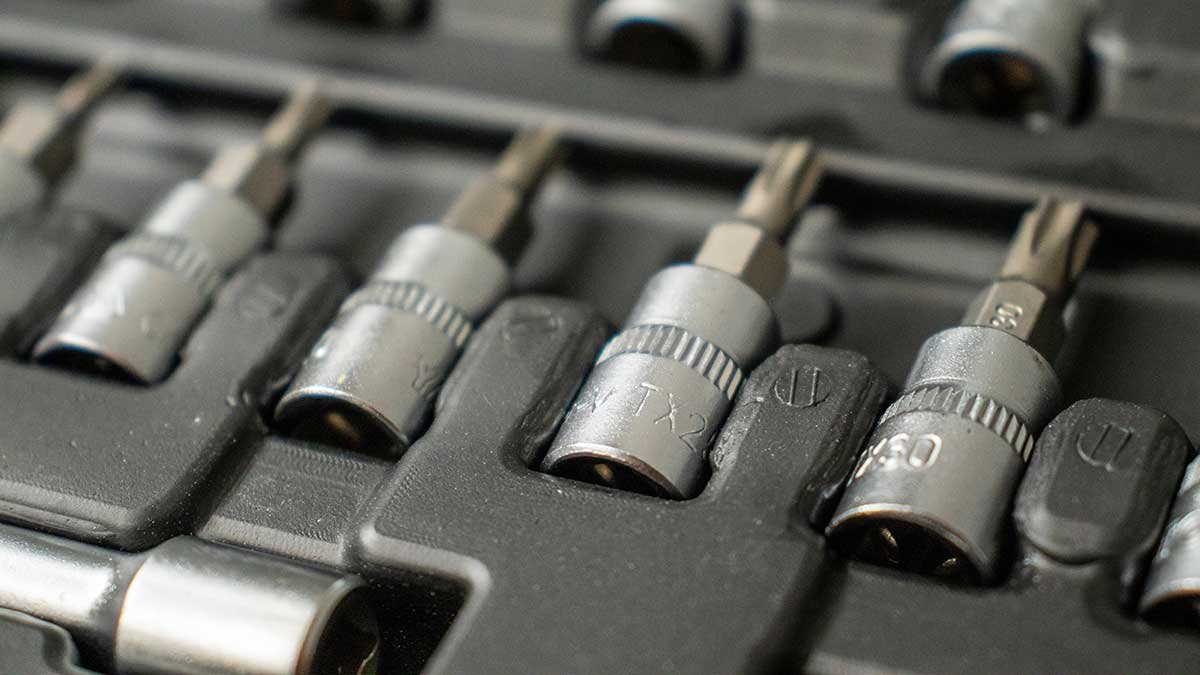
When working with Torx bits, it can be difficult to determine the right size for every fastener and job. You'll need to understand the differences between metric and SAE sizes, for example, and you may also need to consider both external and inverted Torx options.
The sizing system can be confusing, but if you work in electronics or appliance repair, work with automotive vehicles and machinery, or even in high-torque industrial settings, understanding Torx sizing can be essential to your job. Use the charts below as a guide and quick reference whenever you need to choose Torx bits for a job.
What Are Torx Bits?
A Torx bit is a type of screwdriver bit with a six-point, star-shape pattern tip, designed to fit screws with a matching star-shaped recess. It was developed by a company called Camcar Textron in the 1960s as a way of improving on basic designs like Phillips or flathead screws. Its unique shape provides better torque transfer and reduces the risk of "cam-out"—when the bit slips out of the screw head—making it ideal for applications requiring precision and durability.
Understanding Torx Bit Sizes
Torx bits are available in a wide range of sizes and use a "T" numbering system for identifying the size of a bit and matching screw. Sizes such as T10 and T50 designate the width and depth of the bit, with larger numbers corresponding to a larger bit size. The actual measurements are not included in the size—for example, T10 corresponds to a 2.8mm bit.
T1 through T10 are the smallest and most precise bits, used for jobs like electronics repair, while T15 to T30 may be used with vehicle parts, bikes, and larger equipment. T40 and above are more commonly used in heavy-duty applications involving machinery or industrial work. Odd sizes like T47 are less common and are mainly used in specialty jobs.
Use the two charts below to understand the sizing and measurements of each Torx bit and how it corresponds to the Torx screws you're working with.
Standard Torx Bit Size Chart
The following is a Torx bit size chart for internal Torx screws. Two dimensions are important with respect to Torx screws: point-to-point measurements and the diameter of the screw threads.
| Point to Point | Maximum Torque | |||
| Torx Size | inch | mm | Diameter | Nm |
| T1 | 0.031 | 0.78 | — | 0.02 – 0.03 |
| T2 | 0.036 | 0.91 | — | 0.07 – 0.09 |
| T3 | 0.046 | 1.17 | — | 0.14 – 0.18 |
| T4 | 0.05 | 1.27 | — | 0.22 – 0.28 |
| T5 | 0.055 | 1.4 | — | 0.43 – 0.51 |
| T6 | 0.066 | 1.67 | M2 | 0.75 – 0.9 |
| T7 | 0.078 | 1.98 | M2.5 | 1.4 – 1.7 |
| T8 | 0.09 | 2.3 | M2.5 | 2.2 – 2.6 |
| T9 | 0.098 | 2.5 | M3 | 2.8 – 3.4 |
| T10 | 0.107 | 2.71 | M3 – M3.5 | 3.7 – 4.5 |
| T15 | 0.128 | 3.25 | M3.5 – M4 | 6.4 – 7.7 |
| T20 | 0.151 | 3.83 | M4 – M5 | 10.5 – 12.7 |
| T25 | 0.173 | 4.4 | M4.5 – M5 | 15.9 – 19 |
| T27 | 0.195 | 4.95 | M4.5 – M5 – M6 | 22.5 – 26.9 |
| T30 | 0.216 | 5.48 | M6 – M7 | 31.1 – 37.4 |
| T40 | 0.26 | 6.6 | M7 – M8 | 54.1 – 65.1 |
| T45 | 0.306 | 7.77 | M8 – M10 | 86 – 103.2 |
| T50 | 0.346 | 8.78 | M10 | 132 – 158 |
| T55 | 0.44 | 11.17 | M12 | 218 – 256 |
| T60 | 0.519 | 13.18 | M14 | 379 – 445 |
| T70 | 0.61 | 15.5 | M16 | 630 – 700 |
| T80 | 0.69 | 17.52 | M18 | 943 – 1048 |
| T90 | 0.784 | 19.91 | M20 | 1334 – 1483 |
| T100 | 0.871 | 22.12 | M22 | 1843 – 2048 |
External Torx Bit Size Chart
The following chart lists measurements for external Torx bit sizes (also referred to as inverted Torx bits).
| External Torx Size | Point to Point | Screw Diameter | |
| inch | mm | ||
| E4 | 0.15 | 3.8 | M3 |
| E5 | 0.185 | 4.7 | M4 |
| E6 | 0.22 | 5.7 | M5 |
| E7 | 0.244 | 6.2 | M6 |
| E8 | 0.3 | 7.5 | M6 – M7 |
| E10 | 0.37 | 9.4 | M8 |
| E11 | 0.4 | 10.1 | — |
| E12 | 0.43 | 11.1 | M10 |
| E14 | 0.5 | 12.9 | M12 |
| E16 | 0.57 | 14.7 | M12 |
| E18 | 0.65 | 16.6 | M14 |
| E20 | 0.72 | 18.4 | M16 |
| E24 | 0.87 | 22.1 | M18 |
Find All the Torx Bits You Need
Understanding Torx bit sizes can be crucial because using the correct size ensures a secure fit in the screw, preventing damage to both the screw and the bit. Using the right size also improves torque application, making every job faster, more efficient, and safer.
Shopping for Torx bits, Torx screws, and related products for your business? Find everything you need to get the job done at Zoro.com!
Product Compliance and Suitability
The statements contained in this guide are intended for general informational purposes only. Such statements do not constitute a product recommendation or representation as to the appropriateness, accuracy, completeness, correctness, or currentness of the information provided. Information provided in this guide does not replace the use by you of any manufacturer instructions, technical product manual, or other professional resource or adviser available to you. Always read, understand, and follow all manufacturer instructions.
