


Welding Cable Size Chart & Ampacity Guide
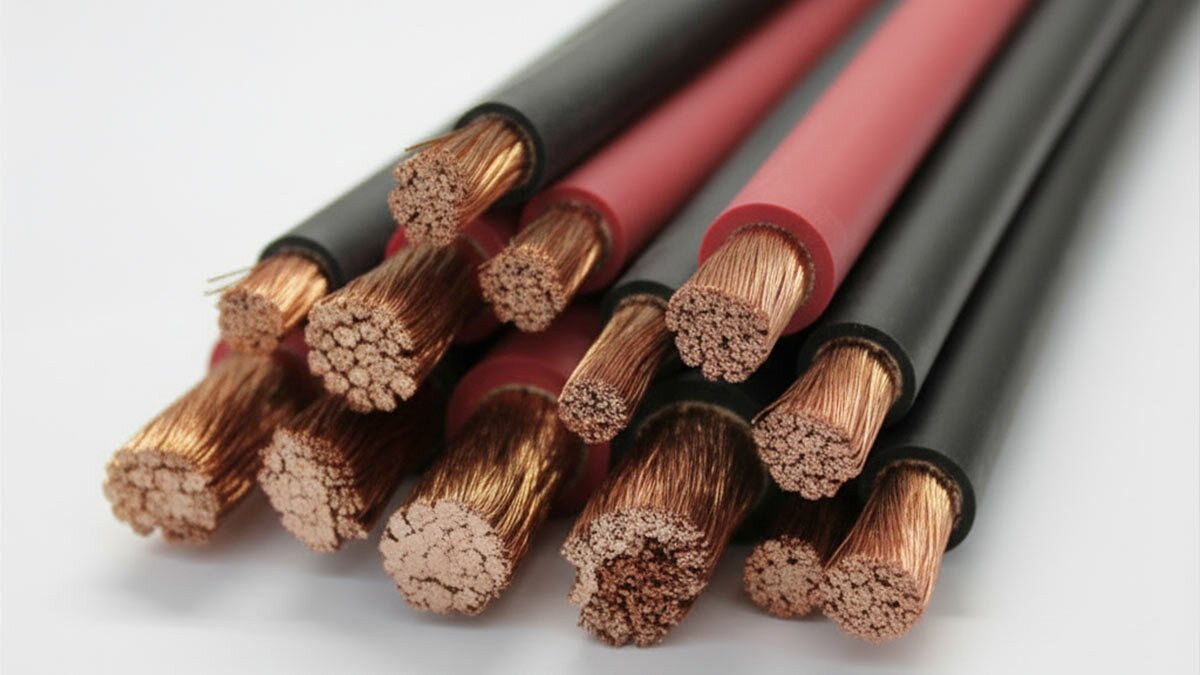
Selecting a welding cable isn’t just about amps and gauges; it’s about safety, performance, and efficiency. The right cable helps your welder deliver consistent power while protecting your equipment and your team. This guide breaks down everything you need to know about cable size, ampacity, and type so you can make confident decisions for your shop or jobsite.
Why Welding Cable Size Matters
Every setup depends on a properly sized welding cable to carry current safely. A cable that’s too small can overheat or drop voltage, affecting weld quality. Too large, and you’re paying for copper you don’t need.
Key factors to consider include:
- Amperage—The total current your welder draws.
- Cable length—Longer runs require thicker cable to reduce voltage loss.
- Duty cycle—Higher-duty or continuous welding increases amp demand.
Welding Cable Ampacity Basics
Ampacity is how much current a cable can safely handle. It depends on wire size, insulation, and environment. If your total run is long, or if you’re welding in hot or confined spaces, consider stepping up one cable size.
WELDING CABLE AMPACITIES SINGLE CONDUCTOR
Required Cable Sizes for Welding Cable Application
Length in feet for total circuit for secondary voltages only – do not use this table for 600 Volt in-line applications.
| AMPS | 100' | 150' | 200' | 250' | 300' | 350' | 400' |
| 100 | 4 | 4 | 2 | 2 | 1 | 1/0 | 1/0 |
| 150 | 4 | 2 | 1 | 1/0 | 2/0 | 3/0 | 3/0 |
| 200 | 2 | 1 | 1/0 | 2/0 | 3/0 | 4/0 | 4/0 |
| 250 | 1 | 1/0 | 2/0 | 3/0 | 4/0 | ||
| 300 | 1/0 | 2/0 | 3/0 | 4/0 | |||
| 350 | 1/0 | 3/0 | 4/0 | ||||
| 400 | 2/0 | 3/0 | |||||
| 450 | 2/0 | 4/0 | |||||
| 500 | 3/0 | 4/0 | |||||
| 550 | 3/0 | 4/0 | |||||
| 600 | 4/0 | REQUIRED CABLE SIZES SHOWN IN AWG NUMBERS | |||||
The total circuit length includes both welding and ground leads (based on 4-volt drop) 60% duty cycle.
These values for current-carrying capacity are based on a copper temperature of 60°C (140°F), an ambient temperature of 40°C (104°F) and yield load factors from approximately 32% for the 2 AWG cable to approximately 23% for the 3/0 AWG cable. In actual service, the load factor may be much higher than indicated without overheating the cable as the ambient temperature will generally be substantially lower than 40°C.
Source: https://www.farnell.com/datasheets/1804767.pdf
Common Welding Cable Types
Different environments call for different cable materials and insulation types.
- EPDM or Neoprene Jackets: Flexible, durable, and resistant to abrasion and oil. Great for outdoor or mobile use.
- Fine-Strand Copper: Ideal for frequent movement and tight spaces.
- Standard Copper: Reliable for stationary setups or shorter cable runs.
- High-Temperature Cable: Built for continuous or hot environments.
How to Choose the Correct Welding Cable
- Check your welder’s maximum amperage rating.
- Measure total cable length (electrode and work leads combined).
- Match your needs to a welding cable ampacity chart.
- Select a cable type suited to your work environment.
- Inspect cables regularly for wear, cuts, or loose connectors.
Final Takeaway
Choosing the correct welding cable size helps you get consistent weld quality, protect your equipment, and reduce downtime. With the right ampacity and cable type, you’ll keep your shop running safely and efficiently.
Product Compliance and Suitability
The statements contained in this guide are intended for general informational purposes only. Such statements do not constitute a product recommendation or representation as to the appropriateness, accuracy, completeness, correctness, or currentness of the information provided. Information provided in this guide does not replace the use by you of any manufacturer instructions, technical product manual, or other professional resource or adviser available to you. Always read, understand, and follow all manufacturer instructions. Portions of this article were generated in part by ChatGPT, and edited by a member of the Zoro team.
