
Welding Fume Extractor Guide: How to Choose the Right System
Select the right welding fume extraction unit to keep shop air safe and clean.
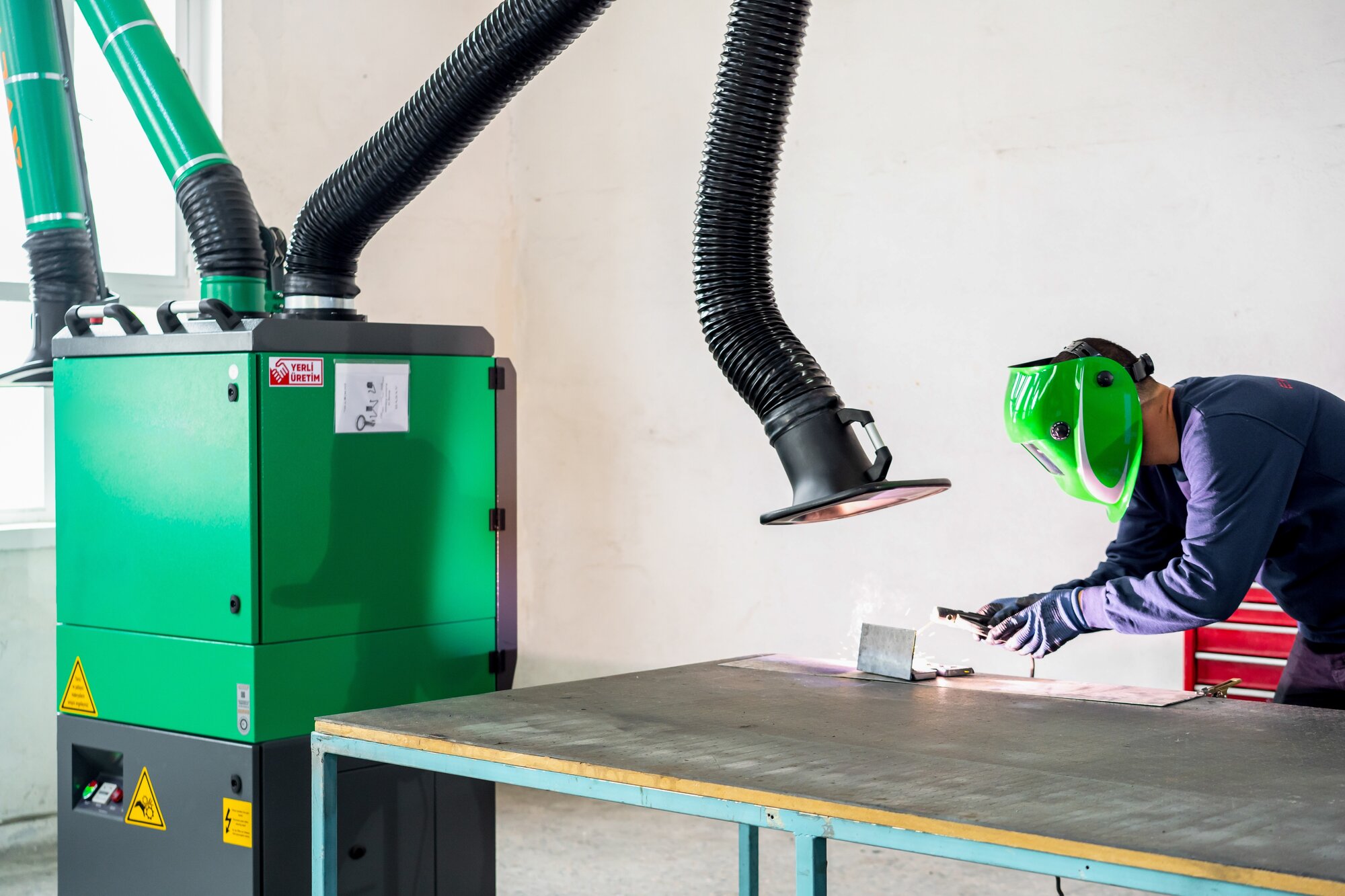
Welding Fume Extractor Guide: How to Choose the Right System
Welding operations can generate fumes, gases, and airborne particles that require appropriate controls. The right welding fume extractor can help capture welding emissions at the source and support a safer, better-managed work environment. However, choosing an extraction system requires more than comparing equipment size or airflow specifications.
Welding processes, materials, production volume, workstation layouts, and ventilation requirements all influence equipment selection. Some operations may benefit from portable extraction units, while others may need extraction arms, dedicated systems, or engineered ventilation solutions. This guide explains the key factors to evaluate when selecting welding fume extraction equipment for a shop or industrial facility.
What Is a Welding Fume Extractor?
A welding fume extractor is equipment designed to capture airborne contaminants generated during welding. Depending on its configuration, the system may draw fumes through a hood or extraction arm, move the contaminated air through a filtration unit, and return filtered air or direct exhaust according to the system design and applicable requirements.
Common configurations include portable extraction units, extraction arms connected to stationary equipment, and centralized extraction systems serving multiple workstations. The appropriate setup depends on the welding process, contaminant characteristics, workspace, and required control strategy.
A fume extractor is not automatically suitable for every welding application. Selection should account for the materials being welded, coatings present on workpieces, process emissions, manufacturer specifications, and the facility's industrial hygiene assessment.
Why Is Welding Fume Extraction Important?
Welding can release airborne contaminants that vary with the process, base metal, filler material, coatings, and operating conditions. Effective controls can help manage exposure and improve the way a welding area handles airborne emissions.
- Capture emissions near the source: Properly positioned extraction equipment can collect fumes before they disperse throughout the workspace.
- Support exposure control: Extraction may be part of a broader program for controlling worker exposure to welding fumes and gases.
- Improve workspace management: A suitable system can help integrate fume control into routine welding operations.
- Support consistent procedures: Equipment selected for the actual application can help establish repeatable extraction practices.
Extraction equipment should be selected and operated as part of a complete exposure-control strategy. It does not eliminate the need to evaluate hazards, follow applicable requirements, or use other controls and protective equipment when needed.
Types of Welding Fume Extraction Systems
Understanding the main system configurations is a useful first step when comparing welding fume extraction equipment.
Portable Welding Fume Extractors
Portable units are designed to be moved between suitable work areas. Depending on the model, they may combine a collection hood or arm, an air-moving component, and a filtration system in one unit.
Portable extraction may be useful when work locations change or when a dedicated stationary installation is impractical. Before choosing a portable unit, check its rated performance, filtration capabilities, duty requirements, and compatibility with the welding process.
Also consider the unit's mobility, power requirements, maintenance access, and the distance between the extraction hood and the welding arc.
Welding Fume Extraction Arms
An extraction arm positions a capture hood near the welding operation. Arms may be connected to a portable extractor, a stationary filtration unit, or a larger extraction system.
The main selection considerations include arm reach, range of motion, hood design, mounting arrangement, and the ability to position the hood effectively without interfering with the work. Operators need to understand how to reposition the hood as the welding task changes.
An extraction arm is only effective when it is correctly positioned and connected to a system capable of providing suitable capture performance for the application.
Fixed and Centralized Extraction Systems
Fixed systems serve designated workstations, while centralized systems may connect multiple collection points to shared extraction and filtration equipment.
These configurations may be appropriate for established production areas or facilities with recurring welding tasks. Selection requires consideration of the number of workstations, duct layout, airflow distribution, maintenance access, and the characteristics of the contaminants being collected.
Centralized systems may require professional engineering to evaluate system performance and ensure that the design suits the facility's operations.
7 Factors to Consider When Choosing a Welding Fume Extractor
1. Welding Process and Materials
Start by identifying the welding processes performed in your facility and the materials involved. Different processes and materials can produce different combinations and quantities of airborne contaminants.
Document the base metals, filler materials, coatings, and workpiece conditions associated with your welding operations. For example, stainless steel, coated metals, and other specialized materials may introduce considerations that differ from those associated with uncoated mild steel.
Use this information to determine what contaminants need to be controlled and what filtration or exhaust arrangements are appropriate. Consult qualified industrial hygiene or ventilation professionals when the hazards or control requirements are uncertain.
2. Capture Hood Placement and Reach
The extraction hood must be positioned appropriately for the task. If the hood is too far from the source or poorly oriented, contaminants may disperse before they are captured.
Consider the size of the workpieces, the welder's normal movements, fixture locations, and whether the hood can be positioned without obstructing the welding process. For extraction arms, evaluate reach, movement, stability, and mounting requirements.
Train operators to reposition the hood as work progresses. Do not assume that a system will perform effectively simply because an extraction arm or hood is installed at the workstation.
3. Airflow and System Performance
Airflow requirements depend on the extraction hood, distance from the source, welding application, duct configuration, and system design. Compare the manufacturer's rated performance with the requirements established for your specific operation.
Review the technical documentation for airflow ratings, static pressure information where applicable, ducting requirements, and operating limitations. A larger airflow number alone does not establish that a system will provide adequate capture at the welding source.
For fixed or centralized installations, have the system design evaluated for the number of collection points and the expected operating conditions. Performance should be verified under actual working conditions.
4. Filtration Requirements
Filtration needs depend on the contaminants generated and the equipment's intended application. Review the manufacturer's information on filter type, filtration performance, compatible contaminants, replacement intervals, and maintenance procedures.
Determine whether the system is designed for the materials and processes used in your facility. Do not assume that a filter suitable for one welding application is appropriate for every type of fume, gas, vapor, or particulate.
Also establish how used filters will be inspected, replaced, and handled. The appropriate handling process depends on the contaminants collected and applicable requirements.
5. Portable, Fixed, or Centralized Installation
The layout of your facility can help determine which extraction configuration makes sense.
- Portable systems: Consider these when extraction needs move between suitable work areas.
- Extraction arms: Consider these when operators need a movable capture hood positioned near a recurring work location.
- Fixed systems: Consider these for designated workstations with stable layouts and consistent tasks.
- Centralized systems: Evaluate these when multiple workstations may be served by a shared engineered system.
These are general selection considerations, not a substitute for an application-specific ventilation assessment. Confirm that the chosen system can meet the required performance at every intended collection point.
6. Maintenance and Operating Costs
Purchase price is only one part of the cost of operating a welding fume extractor. Consider filter replacement, routine inspections, cleaning, energy use, maintenance access, and service availability.
Review how the equipment indicates filter loading or maintenance needs, if applicable. Confirm that replacement filters and service components are available for the selected model.
For fixed and centralized systems, include ductwork, installation, commissioning, and periodic performance checks in the planning process. The total cost will depend on the system design and facility requirements.
7. Safety, Training, and Compliance
Welding fume extraction should be part of a broader program for identifying and controlling workplace hazards. The correct equipment depends on the process, materials, exposure conditions, and applicable workplace requirements.
Before selecting or installing a system, consider the following:
- Whether the system is appropriate for the contaminants generated.
- Whether the hood can be positioned effectively during normal work.
- Whether the equipment's filtration and exhaust arrangements fit the application.
- Whether operators understand proper use and limitations.
- Whether inspection and maintenance procedures are documented.
- Whether additional ventilation, exposure monitoring, or respiratory protection is needed based on the hazard assessment.
Do not treat the presence of an extractor as proof that exposure is adequately controlled. Follow applicable requirements and use qualified professionals to evaluate uncertain or complex applications.
How to Match a Welding Fume Extractor to Your Shop
| Work Environment | Potential System Considerations | What to Verify |
|---|---|---|
| Small fabrication shop | Workstation layout, intermittent welding, and available floor space | Process compatibility, capture performance, mobility, and power requirements |
| Repair and maintenance shop | Changing workpieces, varying tasks, and access around equipment | Hood positioning, arm reach, suitability for the materials, and ease of maintenance |
| Production welding area | Recurring tasks, production volume, and multiple operators | Required airflow, workstation coverage, filtration, and system performance |
| Multi-station industrial facility | Multiple collection points, duct routing, and coordinated operation | Engineering requirements, airflow distribution, maintenance access, and system design |
Use these examples to identify the questions that need to be answered during equipment selection. The final configuration should be based on the actual welding processes, contaminant hazards, facility layout, and required control performance.
Welding Fume Extractor Buying Checklist
Use this checklist when comparing welding fume extraction equipment.
- Process compatibility: Have you identified the welding processes, base metals, filler materials, and coatings involved?
- Contaminant assessment: Do you understand which fumes, gases, or particles require control?
- Capture location: Can the hood be positioned appropriately near the source throughout the task?
- Airflow: Does the manufacturer's rated performance meet the application requirements?
- Filtration: Is the system designed for the contaminants generated?
- Configuration: Is a portable, fixed, extraction-arm, or centralized arrangement appropriate?
- Installation: Have you checked the required space, utilities, ductwork, and mounting arrangements?
- Maintenance: Have you reviewed filter replacement, inspection, and service requirements?
- Operator training: Are instructions available for correct positioning, operation, and maintenance?
- Exposure control: Has the complete control strategy been evaluated for the actual workplace hazards?
Frequently Asked Questions
What does a welding fume extractor do?
A welding fume extractor is designed to capture airborne contaminants generated during welding. Depending on its configuration, it may use a hood or extraction arm to collect fumes and move the air through a filtration or exhaust system.
What is the difference between a portable extractor and a fixed system?
A portable extractor can be moved between suitable work areas, while a fixed system serves designated locations. Centralized systems may connect multiple collection points to shared equipment. The best option depends on the welding process, workspace layout, required performance, and installation needs.
How close should a welding fume extraction hood be to the welding area?
The appropriate distance depends on the hood design, system performance, welding task, and manufacturer's instructions. In general, source-capture equipment must be positioned to capture contaminants before they disperse. Follow the system's operating guidance and verify that capture is effective under actual working conditions.
Does a welding fume extractor eliminate the need for a respirator?
Not necessarily. Whether respiratory protection is required depends on the hazards, exposure assessment, effectiveness of engineering controls, and applicable workplace requirements. An extractor should not be assumed to eliminate all exposure.
How often should welding fume extractor filters be changed?
Filter replacement frequency varies by equipment, contaminant loading, operating hours, and manufacturer recommendations. Follow the specified inspection and maintenance schedule, and replace filters according to the manufacturer's instructions and the facility's procedures.
Product Compliance and Suitability
The statements contained in this guide are intended for general informational purposes only. Such statements do not constitute a product recommendation or representation as to the appropriateness, accuracy, completeness, correctness, or currentness of the information provided. Information provided in this guide does not replace the use by you of any manufacturer instructions, technical product manual, or other professional resource or adviser available to you. Always read, understand, and follow all manufacturer instructions. Portions of this article were generated in part by ChatGPT.
