


What Are Step Drill Bits?
Get to know step drill bits and their versatility for drilling different size holes in various materials
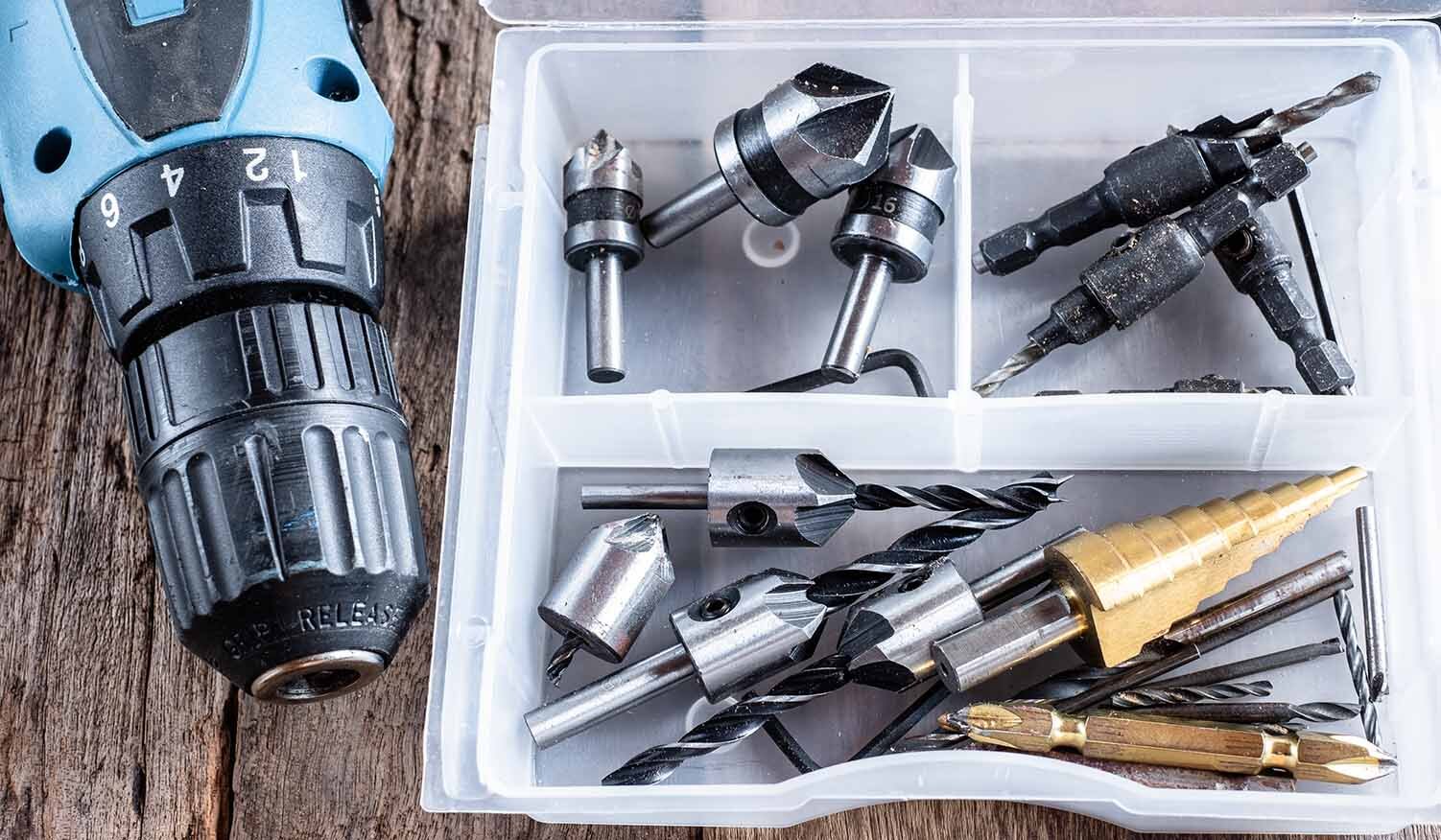
There is a wide array of specialty drill bits available for use on different types of jobs. But when you need to drill into sheet metal, you’re going to need to use what are known as step drill bits.
These bits can drill into metal up to ¼" thick and are, in most cases, conical shaped with a stair-step profile—hence the name “step” drill bits. Step drill bits are common on construction sites and are used to enlarge holes in thin metals, as well as in other materials like plywood, drywall, and particleboard.
Electricians use step drill bits quite frequently, as they are perfect for drilling holes in the thin metal boxes that hold wiring. These bits typically work in groups, with a starter bit used to make an initial small hole and progressively larger bits used to gradually drill the diameter of the hole needed for that particular job or project.
Bit Sizes
The diameter of each step drill bit is usually etched right onto its side for easy reference. The size may be metric or imperial, and refers to the bit’s diameter. Smaller sized bits are often self-starting, with a sharp point at the tip, and therefore don’t require a pilot hole before drilling.
Larger bits are typically cone-shaped and have a blunt tip; therefore they always need a pre-drilled hole that is the same size as the smallest step on that particular bit. In many cases, this initial hole is drilled by first using a center punch to create an indention in the metal at the exact point you plan to drill.
An added benefit of step drill bits is they can also be used to deburr, or clean out, shavings that gather up inside holes.
Bit Materials
Step drills bits can be made from a variety of materials. Along with the size, the ideal material is determined by the specific needs of the job. Here’s a look at your primary options.
- High-speed steel (or HSS) bits are the least expensive and can handle soft metals, along with other materials such as fiberglass, wood, and plastic. For the most part, these steel bits have replaced carbon-based bits when it comes to drilling into metal.
- Black oxide-coated high-speed steel bits have an added finish that can slow down corrosion, making them more durable and therefore better suited for drilling into harder metals.
- Cobalt bits are more brittle than high-speed steel bits, but also cool down quicker to maintain their stiffness at higher temperatures. They are often used to bore through harder metals like aluminum or stainless steel.
- Titanium-coated bits are more expensive than standard high-speed steel, but the enhanced material stays sharper longer, making it a good investment if you plan to do a good amount of drilling.
- Carbide-tipped drill bits can stay sharp longer than the other types and are especially good at drilling through brick masonry and tile work.
How to Work with Step Drill Bits
Start with eye protection—either safety glasses or goggles. The shavings produced when drilling into metal are much more dangerous than the particles generated when working with wood.
Find your center. You’ll need a center punch and a hammer to make your center mark (the indentation in which you’ll start drilling your hole). Put the tip of the center punch against the metal or other surface, and whack the blunt end squarely with a hammer. The dent marks the spot.
Get your self-starting drill bit and secure it into the chuck (or holding place) of the motor. Be sure to use cutting and tapping fluid, which serves as a lubricant to help reduce the heat produced by the friction between the spinning drill bit and the metal material being drilled. Add the fluid to the tip of the step drill bit and also place a small dollop on the indented center mark.
Place the self-starting small step drill bit squarely over the center mark and depress the trigger to slowly drill the hole. Use moderate pressure, letting the bit do the heavy lifting. Too much pressure can generate heat, which will dull your bits prematurely. Make sure the bit drills completely through, using more fluid as needed if the bit starts to heat up. If it smokes, stop drilling immediately and let your drill and bit cool off before starting again.
Next, remove the small step bit and replace with the large step version. Place the pointed tip of the large step drill bit into the hole and apply more fluid to the bit and around the hole. Push the trigger again and continue to drill, adding fluid periodically, until you have the hole size needed for the job. Repeat with progressively larger step drill bits if needed.
When you’re done, take the large step bit off of your drill and clean along with your other bits. Be sure to use a rag or a fresh drill bit to deburr (or clean the shavings from) the hole. Use a spare rag to dust shavings from your bits, as well. Then place your bits back in your toolbox so you’re ready for the next job.
Product Compliance and Suitability
The product statements contained in this guide are intended for general informational purposes only. Such product statements do not constitute a product recommendation or representation as to the appropriateness, accuracy, completeness, correctness or currentness of the information provided. Information provided in this guide does not replace the use by you of any manufacturer instructions, technical product manual, or other professional resource or adviser available to you. Always read, understand and follow all manufacturer instructions.
