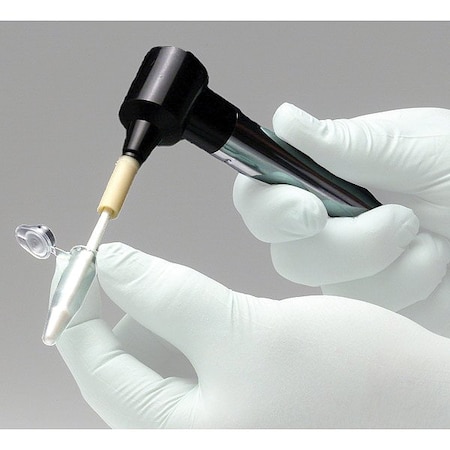
In many laboratory or industrial workplaces, a homogenizer is used to break up infinitesimally small particles in a liquid, so the fluid is even distributed. An ultrasonic homogenizer or high pressure homogenizer uses an electrical signal to create vibrations to break down particles in a laboratory setting. We have the popular homogenizer and ultrasonic processors from such top-brands as Benchmark Scientific and Wheaton. Zoro has probe sonicator models that are in high demand in many laboratory settings. We have many other lab products, including mixers, microscopes accessories, laboratory storage transfer, and laboratory fume hoods too.
Frequently Asked Questions
A homogenizer is a device that uses mechanical force to break down particles into smaller sizes, while an ultrasonic processor uses high-frequency sound waves to create cavitation bubbles that break down particles. Homogenizers are typically used for larger particles, while ultrasonic processors are used for smaller particles.
Homogenizers and ultrasonic processors can improve the quality of products by reducing particle size, improving dispersion, and increasing stability. They can also be used to extract components from cells and tissues, and to create emulsions and suspensions.
There are a variety of homogenizers and ultrasonic processors available, each with its own advantages and disadvantages. Some of the most common types include blade homogenizers, ultrasonic homogenizers, and high-pressure homogenizers.
The best way to choose the right homogenizer or ultrasonic processor for your application is to consult with a technical expert. They can help you assess your needs and recommend the best equipment for your specific application.