Confined Space Entry Equipment Guide
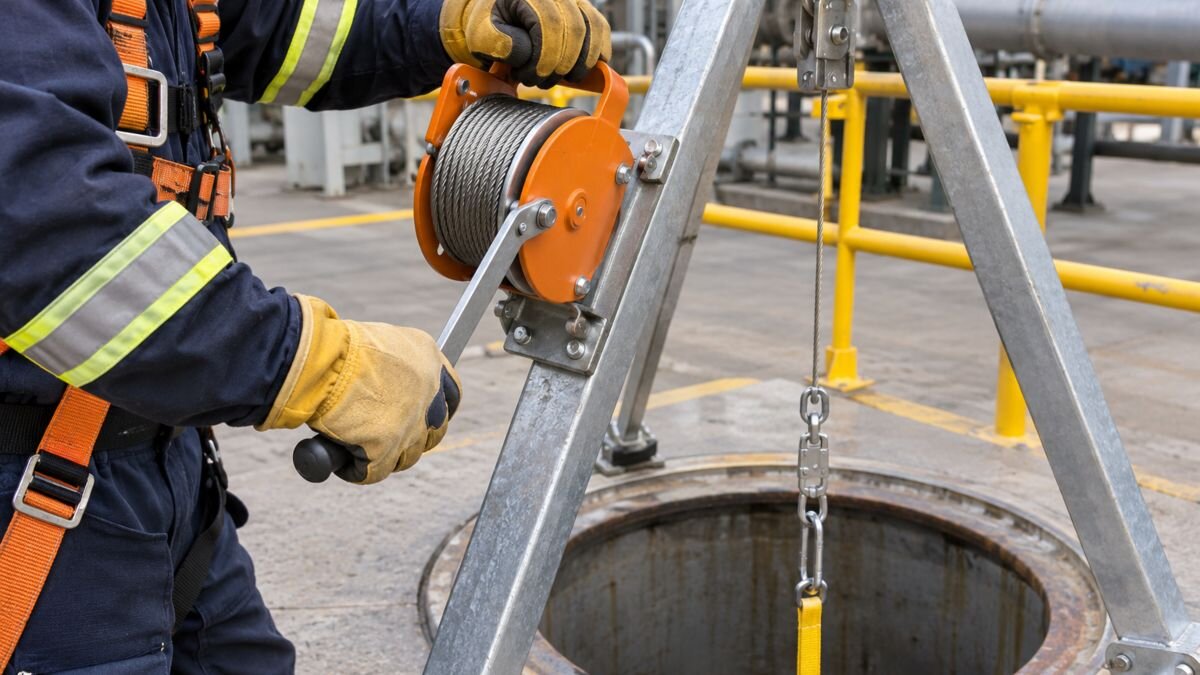
Table of Contents
- What Is Confined Space Entry Equipment?
- What Is a Confined Space Retrieval System?
- Common Types of Confined Space Entry Equipment
- Confined Space Equipment Selection Table
- Confined Space Entry Equipment Checklist
- Confined Space Entry Equipment Safety Considerations
- Frequently Asked Questions
- Build Your Confined Space Equipment Plan
Confined space entry equipment is the gear used to test, control, monitor and respond to hazards when someone enters a confined space. That includes retrieval systems, harnesses, gas monitors, ventilation and communication equipment. The right setup depends on the space, the work and the hazards your assessment identifies. Confined spaces can hold hazards you won't find in ordinary work areas, such as hazardous atmospheres, engulfment, or tight access that makes rescue harder. Equipment is one part of confined space safety. It works alongside a hazard assessment and a documented entry and rescue plan, not in place of them. This guide walks safety managers, maintenance teams and facility pros through the common equipment types and the questions to ask before buying.
What Is Confined Space Entry Equipment?
Confined space entry equipment covers the devices used to assess, control, monitor and respond to hazards when a worker enters a confined space. Depending on the job, that can mean atmospheric monitors, ventilation equipment, retrieval systems, compatible harnesses, communication devices, lighting and protective equipment. No two spaces need exactly the same setup. A system built for one access opening, hazard profile or rescue method may not suit another, so selection starts with your site's documented procedures and applicable requirements.
What Is a Confined Space Retrieval System?
A confined space retrieval system is the equipment used to pull a person out of a space without a rescuer having to go in, which is called non-entry rescue. It's the core of most confined space rescue equipment setups, and a typical system includes a tripod or davit, a retrieval winch or self-retracting device, connectors, and a compatible full-body harness.
OSHA's standard addresses when retrieval is expected. According to 1910.146(k)(3), "To facilitate non-entry rescue, retrieval systems or methods shall be used whenever an authorized entrant enters a permit space, unless the retrieval equipment would increase the overall risk of entry or would not contribute to the rescue of the entrant."
The same paragraph states that "A mechanical device shall be available to retrieve personnel from vertical type permit spaces more than 5 feet (1.52 m) deep." A retrieval system doesn't make an entry safe on its own, and it may not work in every emergency. Internal obstructions, bends or the entrant's position can all get in the way. Your site still needs to confirm that the retrieval method fits the actual space and that the rescue plan covers situations where retrieval could fail.
Common Types of Confined Space Entry Equipment
1. Tripods and Davit Systems
Tripods and davits support retrieval equipment over or beside an access opening. A tripod stands on three adjustable legs over a vertical opening such as a manhole. A davit uses a mast and arm, often on a fixed or portable base, and typical applications include openings where a tripod can't straddle the entry or the setup area is tight.
Before choosing one, review:
- Rated capacity and approved accessories
- Leg span, height range and footprint compared with your actual opening
- Anchoring, base or mounting requirements
- The manufacturer's installation and operating instructions
Tripods, davits and mounts aren't interchangeable. Use only components the manufacturer lists as compatible.
2. Winches and Retrieval Devices
Winches and retrieval devices raise and lower a person or load with a controlled line. In confined space work, common types include manual personnel winches and three-way self-retracting lifelines (SRLs) with a built-in retrieval winch.
Check whether a device is rated for personnel retrieval, material handling or both. Equipment rated only for materials isn't meant for people. Review its ratings, line length and type, operating instructions and inspection steps.
3. Full-Body Harnesses and Connectors
The harness connects the entrant to the retrieval line. According to OSHA 1910.146(k)(3)(i), "Each authorized entrant shall use a chest or full body harness, with a retrieval line attached at the center of the entrant's back near shoulder level, above the entrant's head, or at another point which the employer can establish presents a profile small enough for the successful removal of the entrant."
Look at the harness's intended use, attachment points (many confined space harnesses have shoulder D-rings for upright retrieval), sizing, connector compatibility and inspection requirements. A general fall-protection harness may not be set up for confined space retrieval, so check that every component is approved for that use.
4. Atmospheric Monitoring Equipment
Gas monitors measure the air inside a space before and during entry. OSHA's 1910.146(c)(5)(ii)(C) states that "the internal atmosphere shall be tested, with a calibrated direct-reading instrument, for oxygen content, for flammable gases and vapors, and for potential toxic air contaminants, in that order."
A common configuration is the four-gas monitor, which typically measures oxygen (O₂), combustible gases as a percentage of the lower explosive limit (LEL), carbon monoxide (CO) and hydrogen sulfide (H₂S). Other sensors are available when your assessment identifies other contaminants.
Review sensor options, measurement ranges, calibration and bump-test requirements, and sampling accessories such as pumps and probes for testing before entry. No monitor detects every hazard, so match its sensors to your assessment.
5. Ventilation Equipment
Confined space blowers and ducting move air into a space (supply) or pull contaminated air out (exhaust). The right setup depends on the space, its openings, the airflow path, where contaminants come from and the work being done.
Review airflow ratings, duct length and diameter, power source and placement. Keep the intake away from exhaust sources such as engines. Ventilation supports other controls but doesn't replace atmospheric testing, monitoring or entry procedures.
6. Communication and Supporting Equipment
Entrants and attendants need a dependable way to communicate, whether by voice, radio, hardwired system or line signals. Depending on the entry plan, supporting equipment may also include lighting, protective clothing, respiratory protection and task-specific tools.
In a potentially hazardous atmosphere, check that electronics and lighting are rated for the classified location. Plan for supporting gear in your entry and rescue plan from the start.
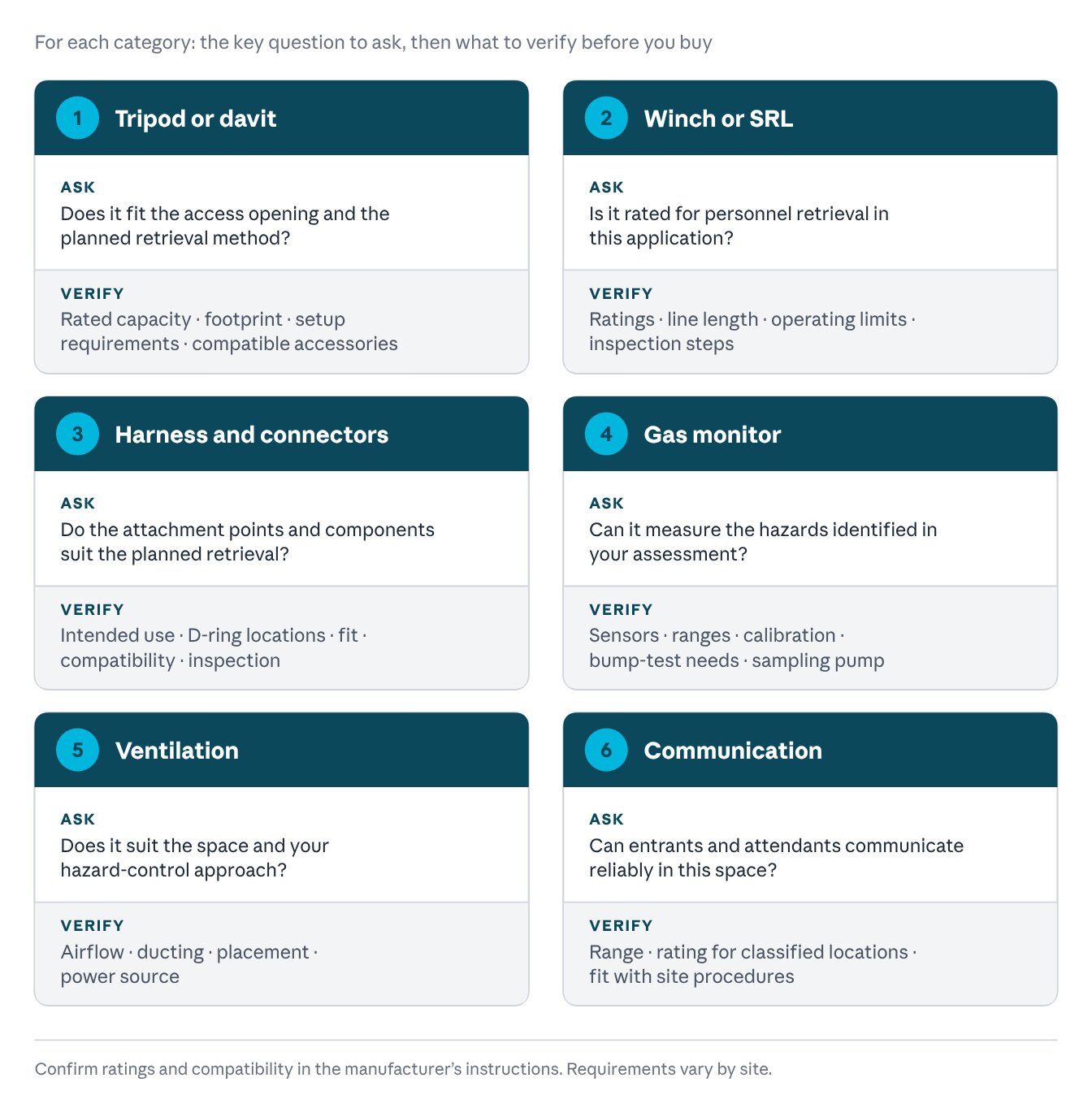
Confined Space Equipment Selection Table
Use this table to compare what to ask and what to check for each equipment category.
Confined Space Entry Equipment Checklist
Use this checklist as a purchasing and planning aid. It does not replace a confined space hazard assessment, entry permit, or rescue plan.
- Space assessment: The space, opening, hazards and work activities have been evaluated.
- Retrieval method: The planned method has been assessed against the actual space.
- Support structure: The tripod, davit or other support fits the opening and setup area.
- Retrieval device: The winch or SRL is rated for personnel retrieval in this use.
- Harness and connectors: All components are compatible and suited to the planned retrieval.
- Atmospheric monitoring: The monitor's sensors match the identified hazards, and calibration is current.
- Ventilation: The ventilation approach has been evaluated for the space and contaminants.
- Communication: Entrants and attendants have a tested way to communicate.
- Inspection: Inspection, maintenance and removal-from-service steps are documented.
- Training: Everyone involved has been trained for their role.
- Rescue plan: A documented rescue plan covers this space and its hazards.
Confined Space Entry Equipment Safety Considerations
Equipment decisions should align with your facility’s confined space program, entry procedures, applicable regulations, and the manufacturer’s instructions. OSHA’s permit-required confined spaces standard provides requirements for covered workplaces.
Keep these points in mind:
- Follow your site’s hazard assessment, permit, and entry procedures before entry.
- Test the atmosphere with a calibrated instrument according to your monitoring procedures and OSHA’s specified testing order.
- Use ventilation, isolation, communication, and monitoring equipment as outlined in the entry plan.
- Use retrieval equipment only for its intended application and within its stated ratings.
- Confirm that all components are compatible and installed or configured according to manufacturer instructions.
- Inspect equipment before use as directed by the manufacturer, and remove damaged or nonconforming components from service.
- Confirm rescue arrangements and equipment account for the specific space, identified hazards, and reasonably foreseeable emergencies.
- Treat retrieval systems as one element of the overall rescue plan.
Requirements may vary by workplace, confined space classification, identified hazards, and jurisdiction. Qualified personnel should review equipment selections and entry procedures before use.
Frequently Asked Questions
What equipment is needed for confined space entry?
It depends on the space, the work and the hazards identified in your assessment. Common equipment includes a gas monitor, ventilation, a retrieval system (tripod or davit, winch or SRL, and harness), and communication devices. Your site's assessment and entry plan determine what's required.
What's the difference between a confined space and a permit-required confined space?
According to OSHA 1910.146, a permit-required confined space is a confined space that "has one or more of the following characteristics," including a space that "Contains or has a potential to contain a hazardous atmosphere" or "Contains a material that has the potential for engulfing an entrant." See the Key terms table above for the full list.
What is a confined space retrieval system?
It's equipment used to retrieve a person from a space without a rescuer entering, called non-entry rescue. A typical system includes a tripod or davit, a retrieval winch or SRL, connectors and a full-body harness, all rated to work together.
What's in a confined space kit?
Most kits include a tripod, a personnel retrieval winch or three-way SRL with a mounting bracket, a full-body harness, connectors and storage bags. Gas monitors and ventilation are often sold separately, so compare kit contents with your entry plan.
What's the difference between a tripod and a davit?
A tripod stands on three legs over a vertical opening such as a manhole. A davit uses a mast and boom on a fixed or portable base, and typical applications include openings a tripod can't straddle or areas with limited room. The right choice depends on your opening and setup area.
Do you need a winch for confined space entry?
OSHA 1910.146(k)(3)(ii) states that "A mechanical device shall be available to retrieve personnel from vertical type permit spaces more than 5 feet (1.52 m) deep." For other spaces, review the standard and your rescue plan with qualified safety personnel.
What gases does a four-gas monitor detect?
A four-gas monitor typically measures oxygen (O₂), combustible gases (%LEL), carbon monoxide (CO) and hydrogen sulfide (H₂S). Sensor options vary by model, so choose one that matches the hazards in your assessment.
Can a tripod and winch be used for every confined space?
No. Whether they fit depends on the opening, setup area, internal obstructions, retrieval path, equipment ratings and planned rescue method. Check the full setup against the manufacturer's instructions and your site's rescue plan.
Does a gas monitor make a confined space safe?
No. A gas monitor is one part of hazard assessment and control. It has to be set up for the hazards that may be present and used according to your site's procedures, alongside other controls and rescue arrangements.
How often should confined space equipment be inspected?
Inspection frequency varies by equipment type, manufacturer instructions and site procedures. Many manufacturers call for a check before each use plus periodic formal inspections. Follow the manufacturer's schedule and take damaged equipment out of service.
Build Your Confined Space Equipment Plan
Choose confined space equipment based on the conditions your team will face, including access points, atmospheric hazards, retrieval needs, and communication requirements. Retrieval systems, harnesses, gas monitors, ventilation, and communication equipment each serve a distinct function within your site’s entry and rescue procedures.
Before purchasing, document the space-specific requirements, verify system ratings and component compatibility, and have qualified safety personnel review the planned configuration. Then shop the confined space equipment that supports your documented entry plan.
Sources
- Occupational Safety and Health Administration, 29 CFR 1910.146, Permit-required confined spaces.
AI Product Compliance and Suitability
The statements contained in this guide are intended for general informational purposes only. Such statements do not constitute a product recommendation or representation as to the appropriateness, accuracy, completeness, correctness, or currentness of the information provided. Information provided in this guide does not replace the use by you of any manufacturer instructions, technical product manual, or other professional resource or adviser available to you. Always read, understand, and follow all manufacturer instructions. Portions of this article were generated in part by ChatGPT.