
How to Choose the Right Laser Level for Your Business
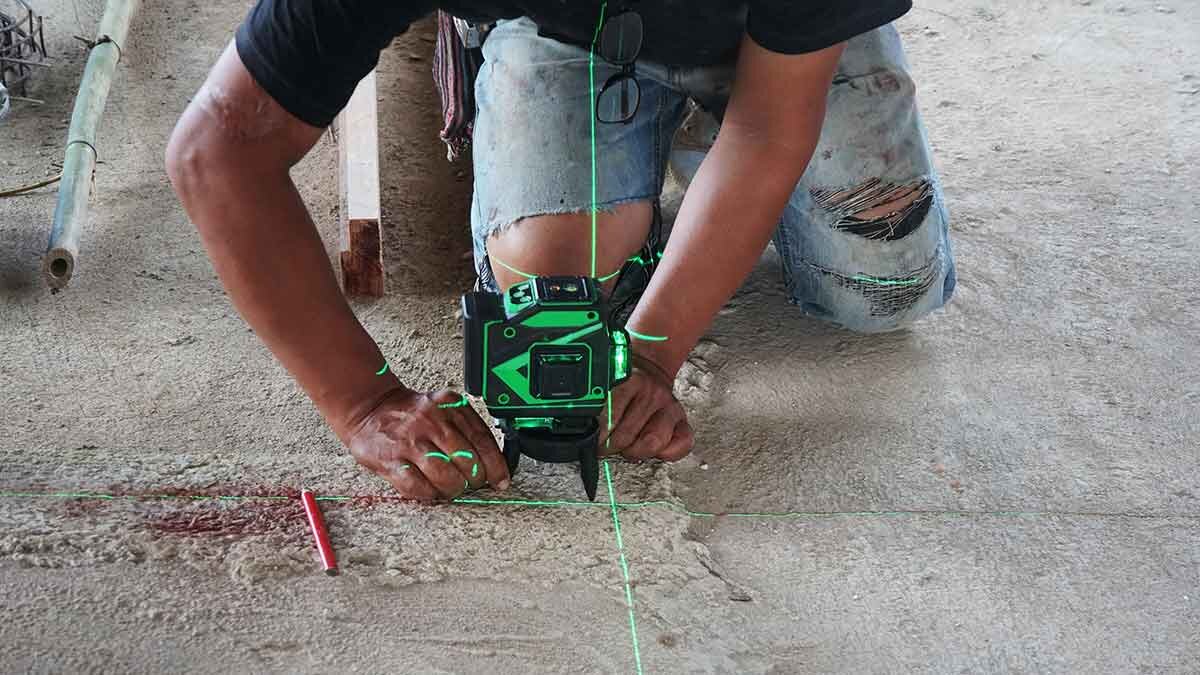
Traditional tools have always been the standard—but laser levels offer one example of a technological advancement that can give an immediate boost to your efficiency and precision. With greater accuracy and ease of use than traditional bubble levels, laser levels are a must-have upgrade for your tool kit, whether you're running a small business or managing a single construction project.
But with so many options available, it can be an overwhelming task to try to find the perfect laser level for your needs. With that in mind, here's everything you need to know about laser levels, from how they're used to the choices that really matter when you're making a purchasing decision.
What Are Laser Levels?
Laser levels shine a straight-line beam of light (or sometimes multiple lines of light) for reference during any type of work that requires leveling. Unlike traditional levels, they can be set up to shine a light on a surface and don't need to be held or kept in place.
Laser levels are much more accurate than traditional (bubble) levels and can be used on virtually any surface. They may also come equipped with other handy features like LED displays, battery readouts, tripods, and rangefinders. Many laser levels are designed to shine both vertically and horizontally at the same time, making it easy to position items during construction work and installations. They may also be used to measure angles and distances, which can be especially important when it comes to construction work and building codes. Accessories are often available with laser levels, too, including clamps, holders, and mounts.
How a Laser Level Works
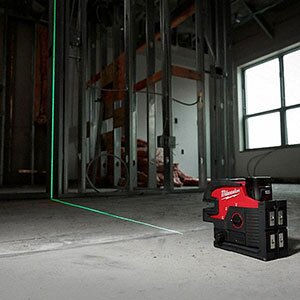
A laser level uses specialized mirrors and lenses inside the device to direct the laser's light beam toward a surface. The light is provided by a simple red (or sometimes green) diode and shaped into a line or a point as needed. Laser levels will generally also contain some type of leveling mechanism, such as a pendulum or gimbal, which may need to be calibrated or adjusted to ensure proper accuracy.
The 3 Main Types of Laser Levels
Here are the key differences between each type of level.
| Dot Laser Levels | Cross-Line Laser Levels | Rotary Laser Levels |
 |
 |
 |
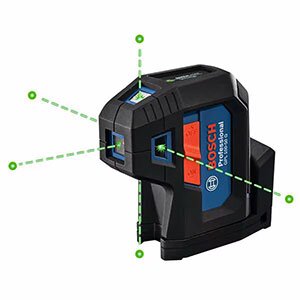
| As the name implies, dot laser levels shine single dots of light on the surface. They will typically shine 3 or more dots of light to provide key reference points, but they don't create a full vertical or horizontal line. |
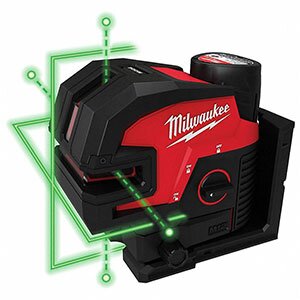
Cross-line laser levels are able to produce full level lines on surfaces. Typically, these laser levels can produce both horizontal and vertical lines, sometimes simultaneously. |
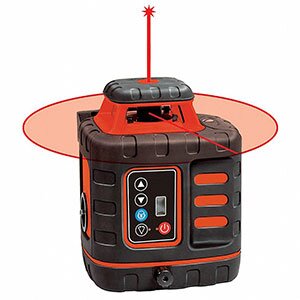
Rotary laser levels shine a spinning beam of light that is moving quickly enough to appear as one solid, circular (360°) plane on your surface. They can be used both horizontally and vertically. These are especially useful in construction, particularly in grading and foundation applications. |
The Benefits of Laser Levels
Precise and Accurate
Laser levels provide a level of accuracy and precision that can't be matched by older bubble levels, with perfectly straight vertical and horizontal lines. While laser levels may need to be calibrated initially, they require much less adjustment and are less prone to issues of human error and estimation. This is especially important for contracting and construction elements that need to be level, plumb, and square from their initial installation to prevent problems down the road.
Efficient and Saves Time
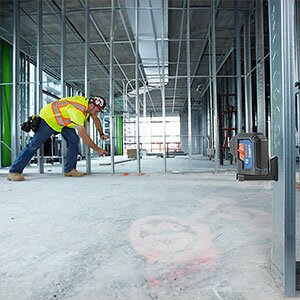
The accuracy and ease of use of laser levels also saves time for workers, providing a boost to overall efficiency and productivity. While traditional bubble levels require repeated setup, checking, and re-checking to ensure that each placement is level, a laser level will allow your team to have a constant straight line (or even a grid) in the workspace. They can also project over long distances for larger projects—and options like rotary laser levels can help your team accomplish tasks that would be impractical with older tools. Because laser levels can be mounted or placed on a tripod, they also free up hands that would otherwise be used to operate levels.
Versatile Across Jobsites
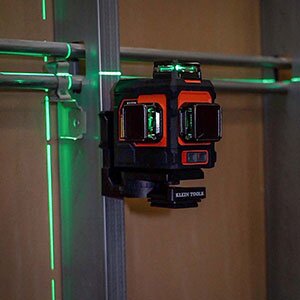
Laser levels are also prized for their versatility and adaptability to various environments and jobsites, whether indoors or outdoors. They're designed for use in many industries and applications, with features like weatherproofing to support their use on the jobsite.
Complements Traditional Levels
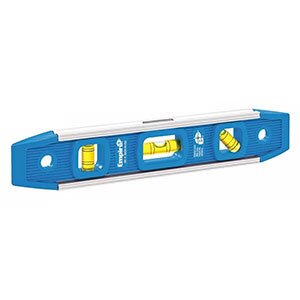
While laser levels may have replaced the older bubble levels in many contexts, it's still worthwhile to have bubble levels in your toolkit. In fact, laser levels provide a useful complement to bubble levels and other hand tools. For example, a traditional level may be better in a pinch for quick tasks or in small spaces where it's not worth the effort to set up a laser level. A bubble level can also be used as a backup or secondary option when you have a laser level in your arsenal.
Other Considerations
Indoor vs. Outdoor Use
Laser levels are often used in combination with a laser line detector, a tool that can be placed on a faraway surface (often hundreds of feet) to detect laser lines. These tools may include a readout screen and/or alert sounds that can tell you when you've positioned the detector in line with the laser level, making it easier to find a level spot on the jobsite when you can't see the laser lines with the naked eye.
For indoor applications, such as drywall work or installations, you'll want to use a red or green laser that does not require a laser detector.
However, for outdoor projects—especially concrete grading and related projects—a laser detector is an essential tool that can make it easier to see your laser lines across distances and in bright conditions. It may also be worthwhile to consider a green laser beam, which is easier to see outdoors.
Self-Leveling vs. Manual Leveling
Laser levels are available in both self-leveling and manual leveling options. A manual laser level will require the user to adjust or calibrate the level before use, while a self-leveling laser level is designed to find the level on its own (without any adjustment by the user).
Green Laser vs. Red Laser
As mentioned above, green light laser levels are brighter and easier to see by the naked eye, especially in outdoor conditions. However, green light levels are typically more expensive and may use more battery power than red light lasers. When it comes to accuracy and precision, there is no difference between the two color options.
* * *
Laser levels have quickly become commonplace tools, replacing older bubble levels with a new technology that makes it easier than ever to check that your work is level, plumb, and square. With many advantages over bubble levels, these highly useful tools make a great addition to your business's toolkit, whether you're running a large company or contracting out of your truck.
Shopping for laser levels and accessories? Find everything you need to get the job done at Zoro.com!
Product Compliance and Suitability
The statements contained in this guide are intended for general informational purposes only. Such statements do not constitute a product recommendation or representation as to the appropriateness, accuracy, completeness, correctness, or currentness of the information provided. Information provided in this guide does not replace the use by you of any manufacturer instructions, technical product manual, or other professional resource or adviser available to you. Always read, understand, and follow all manufacturer instructions.
