
Spray Booth Types Guide
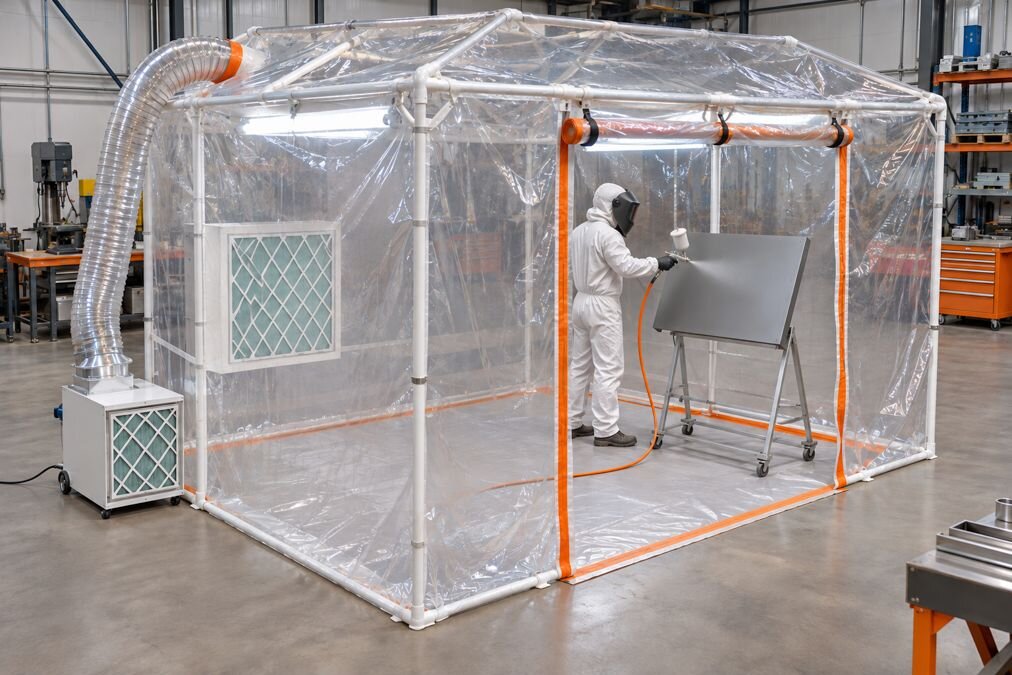
Quick answer: The three main spray booth airflow designs are crossdraft (air moves horizontally), downdraft (air moves from ceiling to floor), and side-draft (air exits through a side wall). There's no single right choice. The fit depends on your coatings, part size, production volume, and building layout.
Picking a spray booth takes more than finding an enclosure big enough for your part. Airflow design, filtration, coating process, material handling, and facility layout all shape how well a booth fits the job.
Whether you're comparing commercial spray booths for a fabrication line, an auto painting booth for a body shop, or a smaller setup for cabinet finishing, this guide walks through the common booth types, the questions worth asking, and what to have on hand before you talk to suppliers.
What Is a Spray Booth?
A spray booth is an enclosed or partially enclosed work area built for spray-finishing operations. A professional spray booth typically combines mechanical ventilation, filtration, and lighting to manage overspray and the finishing environment.
You'll find spray booths in automotive refinishing, woodworking and furniture production, metal fabrication, and industrial maintenance. The right design depends on what you're spraying, what you're spraying it on, and where the booth will live.
A spray booth isn't a universal solution for every coating. Material compatibility, ventilation, fire protection, electrical design, and emissions need to be evaluated for your specific operation, with help from qualified professionals. Spray booths are required by OSHA and NFPA 33 for most commercial and industrial coating operations.
Spray Booth Type Comparison Chart
| Configuration | General airflow | Typical applications | Key considerations |
| Crossdraft | Horizontal, end to end | General industrial parts, sheet metal, equipment refinishing | Intake/exhaust placement, part obstruction, layout |
| Downdraft | Ceiling to floor | Automotive refinishing, larger vertical surfaces | Floor work, installation cost, service access |
| Semi-downdraft | Front ceiling to rear wall | Automotive and general refinishing | Ceiling and rear clearance, airflow balance |
| Side-draft | Across to a side exhaust | Facilities where floor exhaust isn't practical | Side clearance, part geometry, filtration |
| Open-face | Depends on design and opening | Woodworking, smaller parts, bench work | Opening size, containment, part access |
| Enclosed | Depends on intake and exhaust design | Aerospace, OEM auto, Class-A finish lines | Access, material handling, installed systems |
This table describes broad differences. No single design is automatically more effective; actual performance depends on engineering, installation, operation, and maintenance.
Spray Booths by Application
| Application | Typical parts | Booth types often compared |
| Automotive refinishing | Full vehicles, body panels, bumpers | Downdraft, semi-downdraft, crossdraft |
| Sheet metal and fabrication | Panels, enclosures, cabinets, brackets | Crossdraft, side-draft |
| Woodworking | Cabinet doors, furniture parts, panels | Open-face, crossdraft |
| General industrial | Machinery, equipment, production parts | Crossdraft, enclosed, side-draft |
How to Choose a Spray Booth
Start with your process, not the booth. These seven steps help you gather what suppliers and engineers will ask for.
- Identify the coating process. List every coating and solvent, how it's applied, and your expected production rate. Review the safety data sheet (SDS) and technical documentation for each product.
- Measure the workpiece. Record maximum length, width, and height, plus clearance for fixtures, handling equipment, and operator movement.
- Compare airflow designs. Review manufacturer performance data and have a qualified professional evaluate the design for your materials and facility.
- Evaluate filtration. Check filter type, replacement availability, and service access against the manufacturer's instructions.
- Review ventilation and exhaust. Confirm airflow, exhaust routing, and make-up air with qualified ventilation professionals early in the project.
- Assess your facility. Measure ceiling height, doors, electrical service, duct routes, and maintenance clearance. Note any structural or floor work.
- Compare total cost of ownership. Factor in energy, filters, service, parts, downtime, and facility modifications, not just purchase price.
Frequently Asked Questions
What are the main types of spray booths? The common airflow designs are crossdraft, downdraft, semi-downdraft, and side-draft. Booths are also described by enclosure style: open-face or enclosed.
Which type of spray booth is right for my shop? There's no universal answer. It depends on your coatings, part size, airflow needs, building layout, production volume, and maintenance access.
What type of booth do automotive shops use? Many automotive refinishing shops evaluate downdraft, semi-downdraft, or crossdraft auto painting booths. The right fit depends on vehicle size, cure requirements, and building constraints.
What should I look for in a sheet metal paint booth? Focus on part size and shape, how parts move through the booth, airflow around large flat surfaces, and filter capacity for your production volume.
Can a woodworking spray booth be used for other materials? Don't assume so. Check the manufacturer's approved uses and evaluate materials, ventilation, and fire protection before changing processes.
What's the difference between commercial and industrial spray booths? The terms overlap and aren't standardized. Suppliers often use "industrial" for higher-volume or larger-part systems, but always compare the actual specifications.
What should I compare when buying a professional spray booth? Compare the application, part dimensions, airflow design, filtration, ventilation, installation needs, service access, and operating costs.
Does buying a spray booth guarantee regulatory compliance? No. Compliance depends on the complete installation and operation, including materials, ventilation, fire protection, electrical design, maintenance, and local and national requirements.
Shop Spray Booths Built Around Your Process
Explore spray booths designed for your coatings, parts, production flow, and facility requirements. Compare documented specifications and work with qualified ventilation and fire-protection professionals to plan your setup.
AI Product Compliance and Suitability
The statements contained in this guide are intended for general informational purposes only. Such statements do not constitute a product recommendation or representation as to the appropriateness, accuracy, completeness, correctness, or currentness of the information provided. Information provided in this guide does not replace the use by you of any manufacturer instructions, technical product manual, or other professional resource or adviser available to you. Always read, understand, and follow all manufacturer instructions. Portions of this article were generated in part by ChatGPT.


