


Touchless Bathroom Faucets: Your Top 4 Questions Answered!
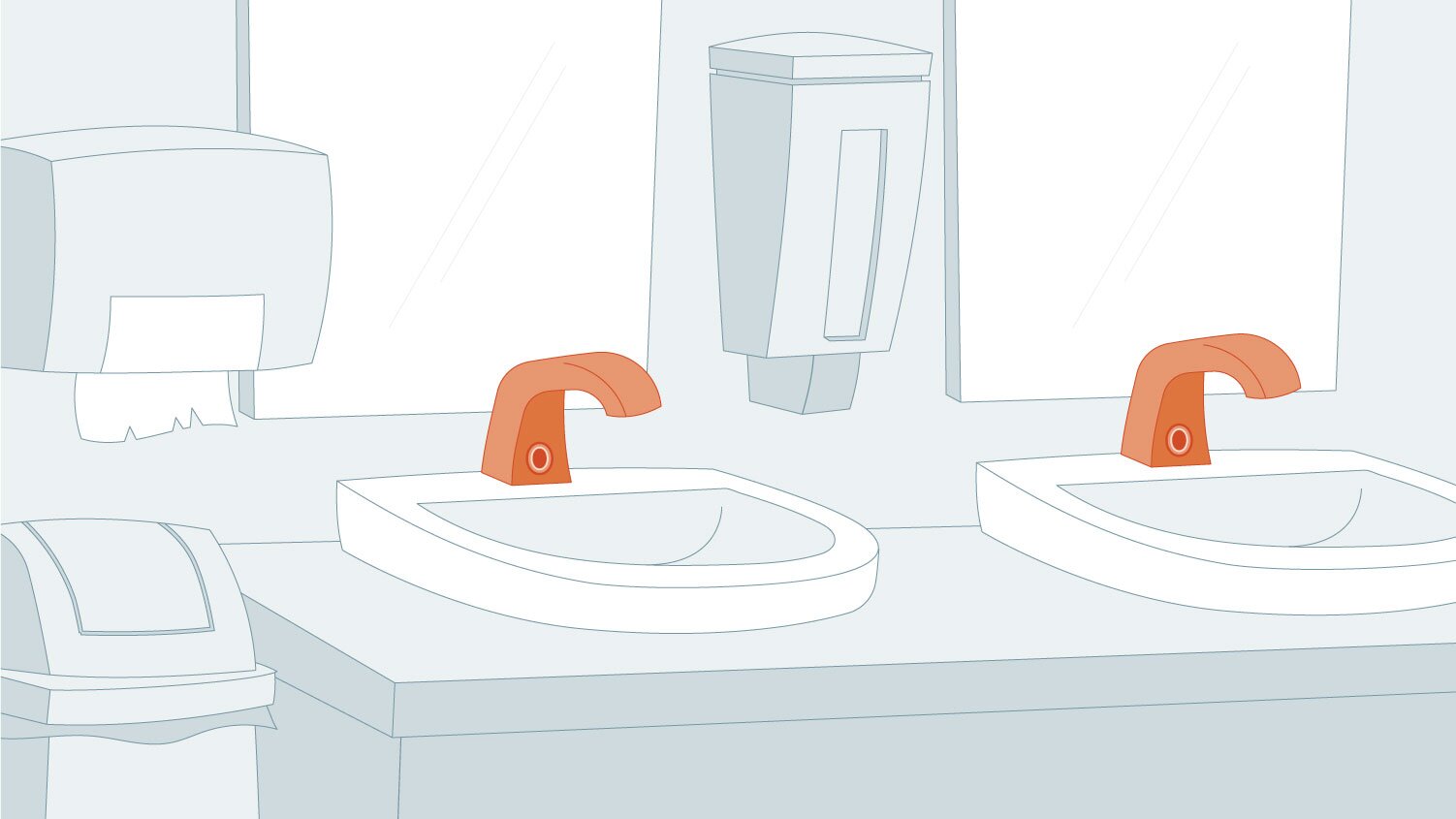
Table of Contents
- How Do Touchless Faucets Work?
- How Are Touchless Faucets Powered?
- Are Touchless Faucets Reliable?
- What Are the Benefits of Touchless Faucets?
If you’re considering installing hands-free faucets in your business’s restrooms, kitchens, or wash stations, you’re not alone. In fact, the touchless faucet industry is expected to grow by nearly 20% between 2022-2030. Touch-free faucets offer business owners plenty of benefits including reduced water costs and an improved carbon footprint. Let’s get started with the four most commonly asked questions about no-touch faucets.
How Do Touchless Faucets Work?
Have you ever stuck your hands under a hands-free faucet and marveled at the crystal-clear stream of water that magically appears? Us, too. So, is the faucet heat-sensored? Motion-sensored? Under the influence of mind control? Let’s get to the bottom of it.
It turns out most touchless bathroom faucets are equipped with infrared sensors at the base of their spouts. Next to the sensor is a small infrared light. When your hands come within a few inches of the spout, the light bounces off your skin, triggering the sensor to turn on the flow of water. Some faucets use an ultrasonic sensor which also activates the flow of water when movement is detected within its field.
How Are Touchless Faucets Powered?
No-touch faucets are usually powered by one of two methods: electricity or a battery. Sinks that use electricity harness the power of a low-voltage current from an AC transformer, while battery-powered models use dry-cell batteries that are usually installed at the faucet’s back.
Are Touchless Faucets Reliable?
How many times have you waved your hands in front of a faucet’s sensor and no water comes out? Too many times to count, right?
It’s true that hands-free faucets can fail, but with regular care, the good outweighs the inconvenience.
Touchless faucets fail due to either a malfunctioning sensor or lack of power. Sensors can become less effective because they’re obstructed by soap scum, oil, or mineral buildup from hard water. Simply clean the sensor’s window first to determine if it’s a sensor problem. If cleaning the sensor window doesn’t fix the problem, then you’ll need to replace or fix your power supply.
What Are the Benefits of Touchless Faucets?
Touchless faucets can help mitigate the spread of harmful germs and bacteria while providing a modern touch to your restroom facilities. Touch-free faucets can also reduce your water consumption, which can cut your water costs and improve your carbon footprint. Hands-free faucets with temperature settings can protect employees and customers from accidental burns. Lastly, hands-free faucets allow foodservice workers to use both hands and can help prevent the spread of foodborne germs.
Hands-free faucets can be a great addition to any workplace. Many industries can benefit from hands-free faucets including healthcare, foodservice, pharmaceutical, manufacturing, and many others. Shop Zoro for all of your facility’s plumbing needs and more.
Recommended articles:
Product Compliance and Suitability
The product statements contained in this guide are intended for general informational purposes only. Such product statements do not constitute a product recommendation or representation as to the appropriateness, accuracy, completeness, correctness, or currentness of the information provided. Information provided in this guide does not replace the use by you of any manufacturer instructions, technical product manual, or other professional resource or adviser available to you. Always read, understand, and follow all manufacturer instructions.
