
Workbench Height Guide: How High Should a Workbench Be?
Table of Contents
Quick answer: Workbench height is usually set relative to your elbow height, not a single universal number. According to the Canadian Centre for Occupational Health and Safety (CCOHS), precision work is typically about 2 in (5 cm) above elbow height, light work about 2–4 in (5–10 cm) below, and heavy, downward-force work about 8–16 in (20–40 cm) below. Measure your elbow height, then adjust for the task.
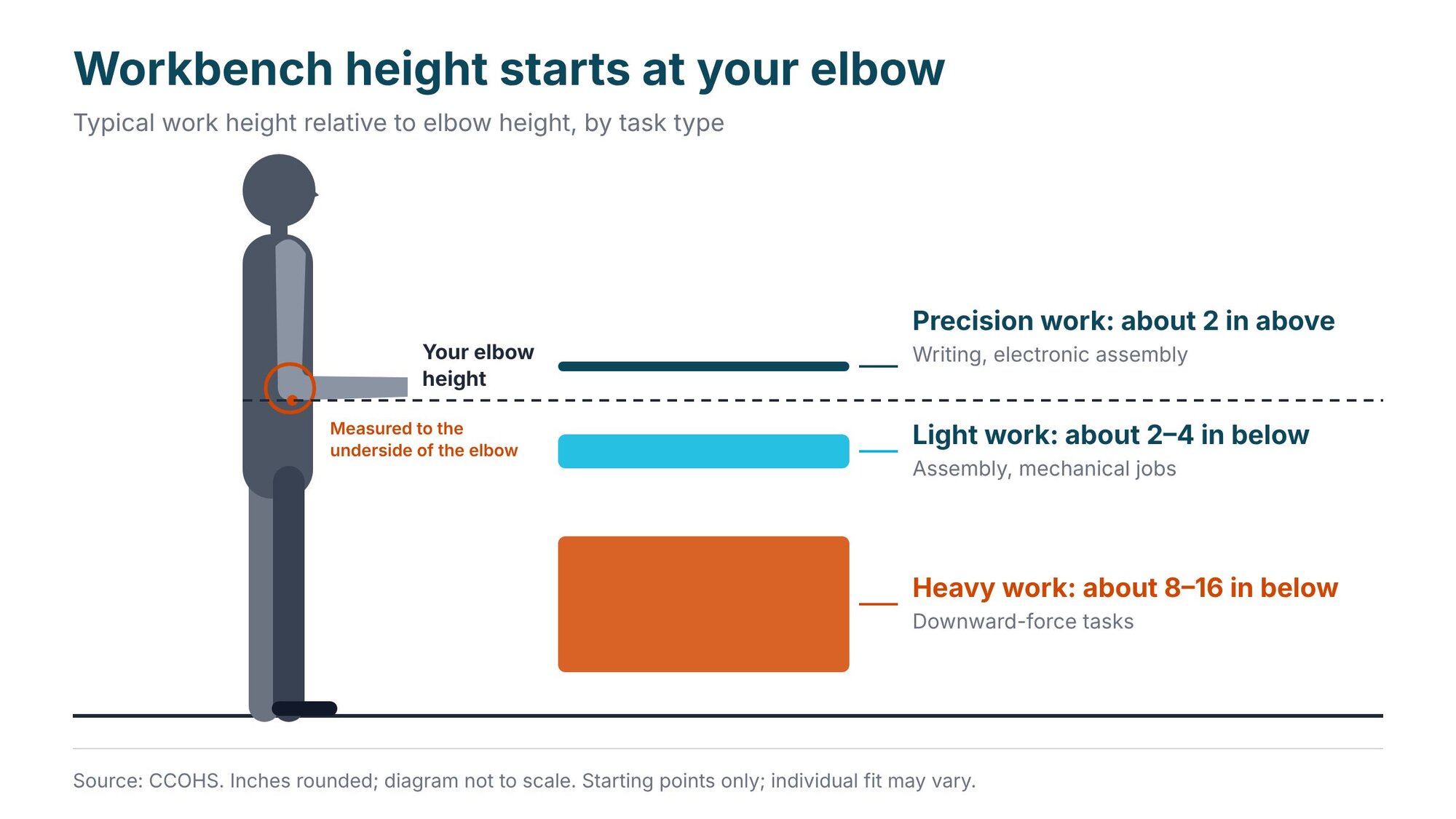
A workbench at the right height lets you reach, see, and control your work comfortably. Too high, and you may end up raising your shoulders. Too low, and you may find yourself bending over the work. The right setup depends on you, the task, and the tools and materials on the bench.
What Is the Standard Workbench Height?
There's no universal workbench height that fits every person or job. Many general-purpose benches are built for common standing work, but your effective working height changes with the task and with anything that raises the workpiece.
That's why ergonomics guidance uses elbow height as the reference point. The Health and Safety Executive (HSE) notes in its conveyor workstation guidance that for most standing tasks the preferred working height is below elbow height, and that only delicate, manipulative tasks need to be done above it.
Workbench height chart by task
The ranges below come from CCOHS; inch values are rounded conversions.
| Task type | Examples (per CCOHS) | Work height relative to elbow |
|---|---|---|
| Precision work | Writing, electronic assembly | About 2 in (5 cm) above; CCOHS notes elbow support is needed |
| Light work | Assembly-line or mechanical jobs | About 2–4 in (5–10 cm) below |
| Heavy work | Tasks that require downward force | About 8–16 in (20–40 cm) below |
In its guidance for close visual work at sewing and inspection stations, the Occupational Safety and Health Administration (OSHA) suggests a table 2 to 4 inches above elbow height when work is hard to see. OSHA notes this can raise the elbows and recommends padded elbow rests for support.
Worked examples. Applying the CCOHS ranges to a few standing elbow heights (measured floor to elbow, in shoes):
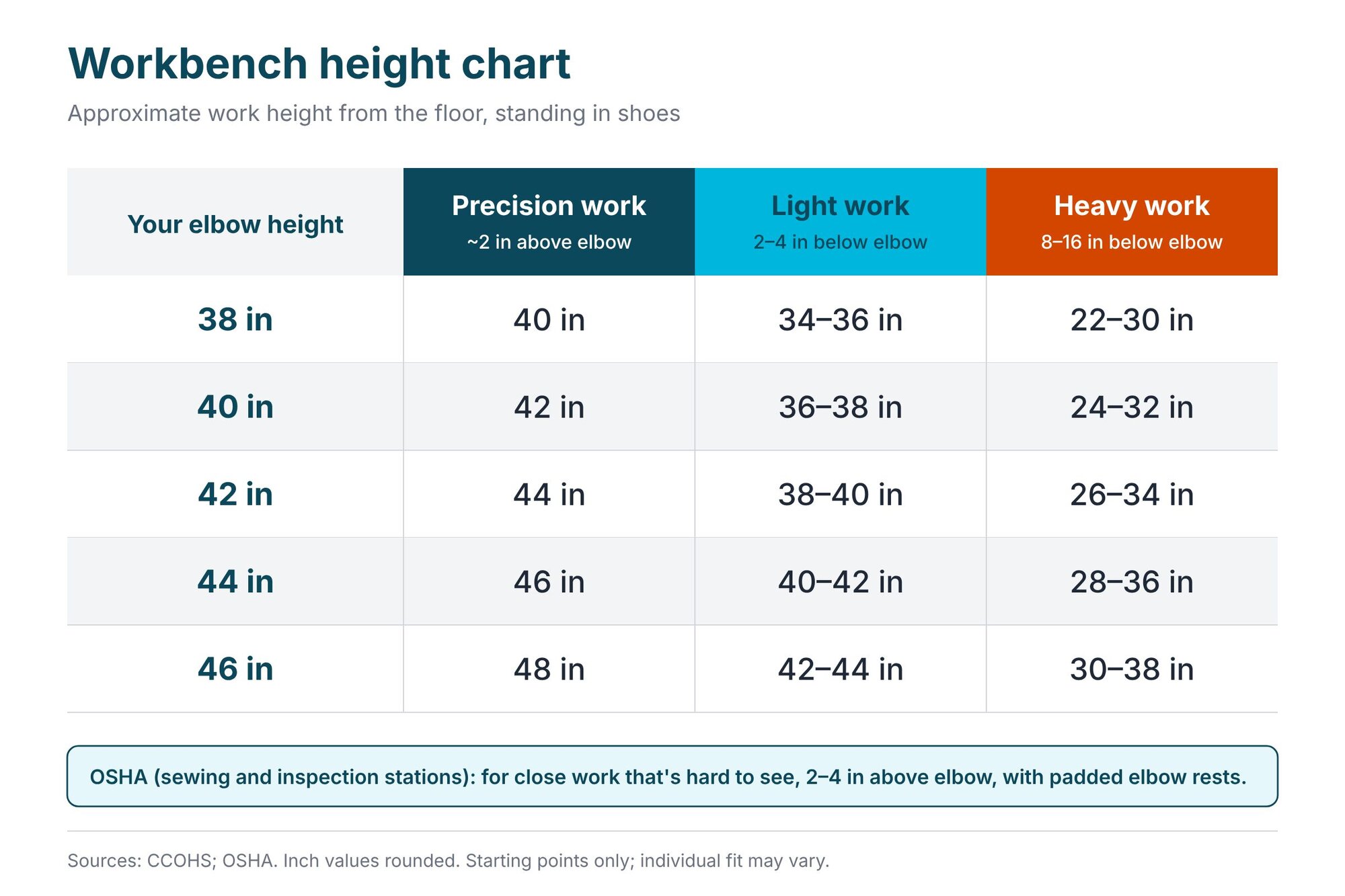
These are starting points. Individual fit may vary, so test the height with a real task before you commit.
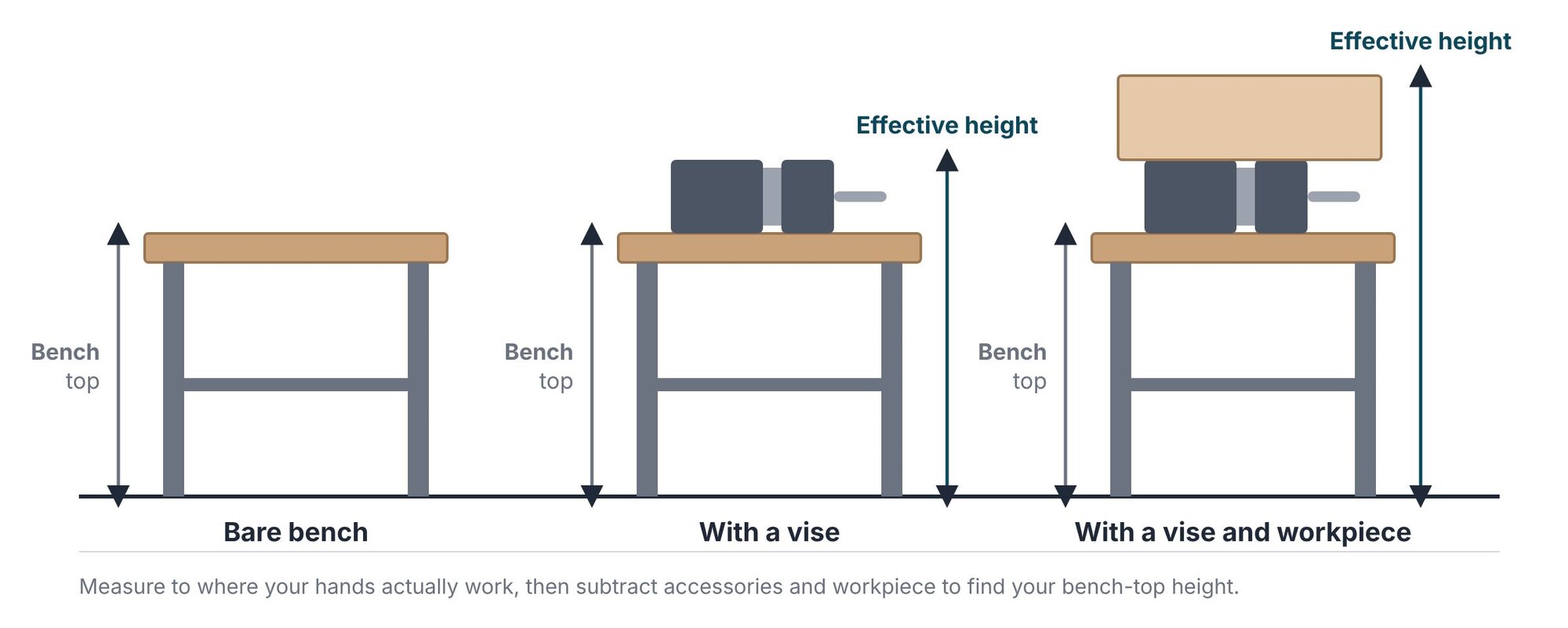
Bench top height vs. effective working height
How to Measure Workbench Height
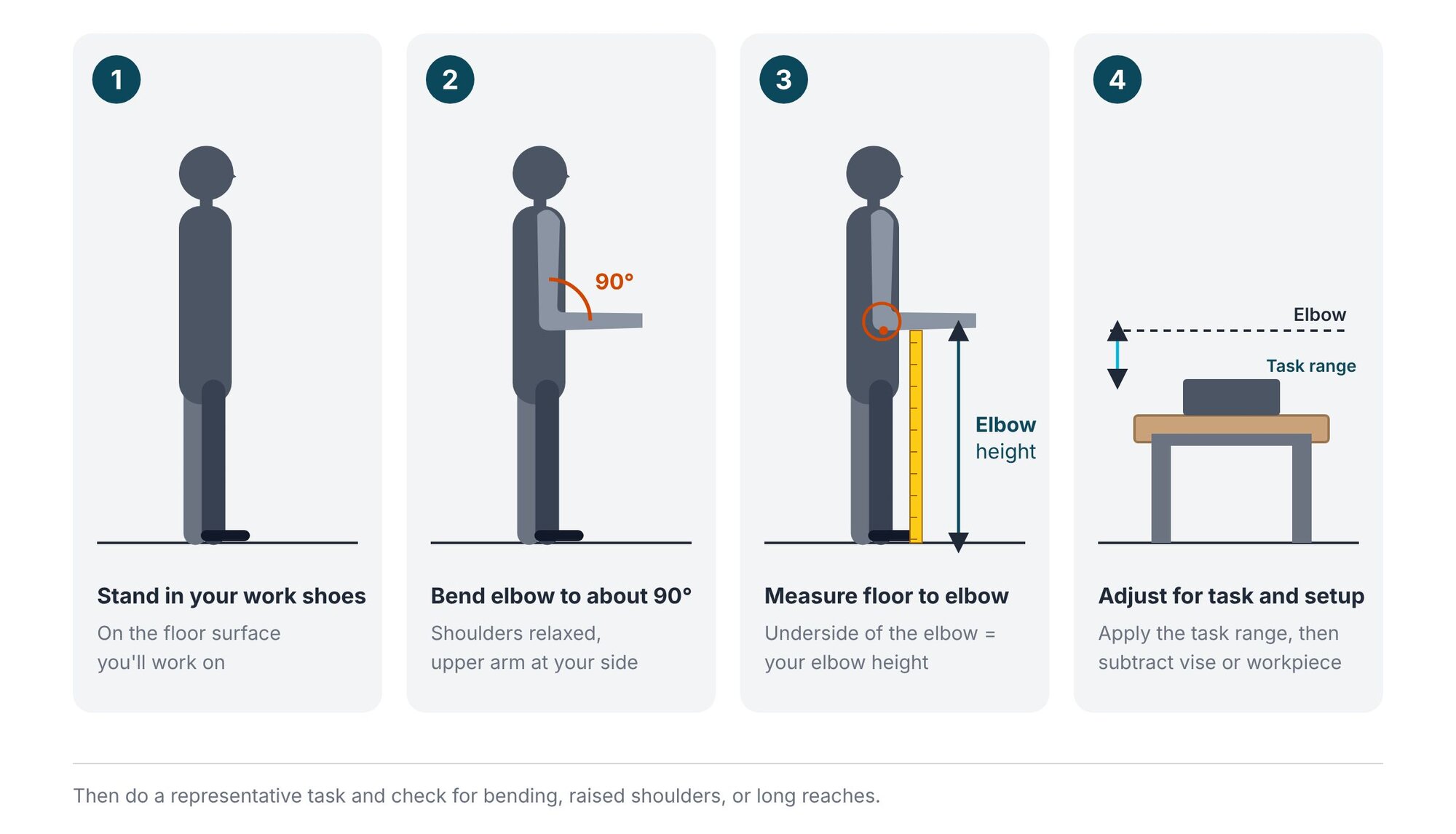
- Stand on the floor surface you'll work on, wearing your usual work shoes.
- Relax your shoulders and bend your elbow to about 90 degrees, upper arm at your side.
- Measure from the floor to the underside of your elbow. That's your elbow height.
- Pick the task range from the chart above and calculate your target working height.
- Subtract the height of any vise, fixture, mat, or typical workpiece to get your target bench-top height.
- Set up the bench and do a representative task. Check whether you're bending forward, lifting your shoulders, or reaching too far.
If several people share the bench, measure each regular user and consider an adjustable model.
How to Choose a Workbench Height
- Start with your working position. You should be able to reach the work without consistently bending forward, raising your shoulders, or stretching across the surface. A height that works for one person may not work for another.
- Match the height to the task. Fine work you need to see up close usually sits higher. Work where you press down or apply force usually sits lower. Consider how much force you apply, how closely you need to see the work, and how far you reach.
- Account for tools, fixtures, and workpieces. The bench top isn't always the working surface. Vises, fixtures, cutting mats, and large materials raise the point where your hands work, so measure the full setup.
- Plan for sitting, standing, or both. CCOHS recommends that working tables and benches be adjustable, and suggests platforms for shorter workers or pedestals for taller ones when a station can't be adjusted.
Seated Workbench Height
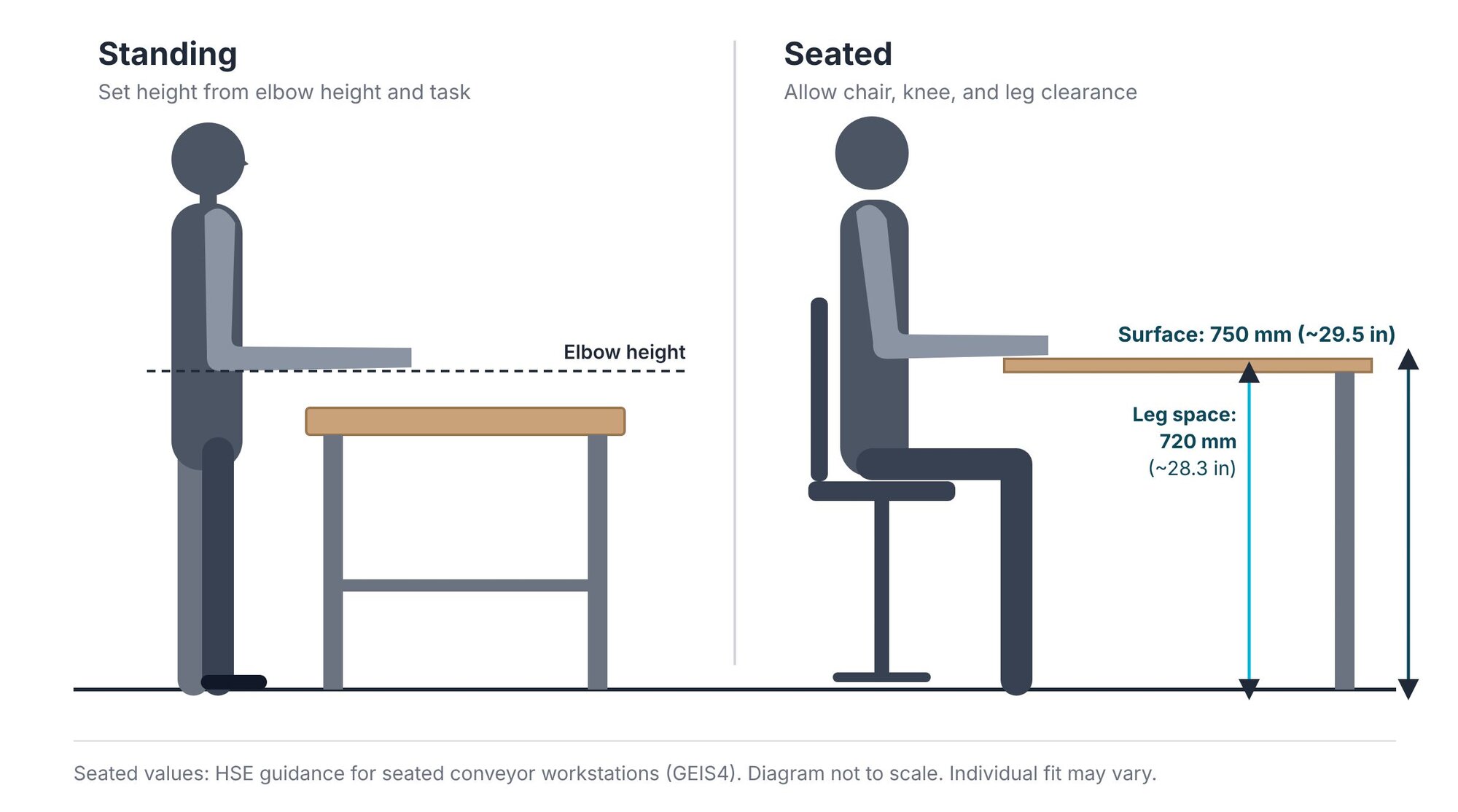
Seated work needs room for your legs and chair, not just the right surface height. As one reference point, HSE's guidance on seated conveyor workstations gives a working surface height of 750 mm (about 29.5 in), leaving 720 mm (about 28.3 in) of leg space from the floor to the underside of the surface. Check that your chair adjusts so your elbows land near the work surface and your knees clear the underside.
Standing vs. Seated Workbench Setup
Woodworking Bench Height
Woodworking tasks vary a lot in force. Planing and other downward-force work tends to fall in the lower, heavy-work range, while layout, joinery, and finishing often sit closer to the light-work range. Thick stock and workholding raise the effective height, so measure with your typical material in place.
Garage and Electronics Benches
A garage bench often handles a mix of repair, assembly, and heavier work, so one option is to set it for light work and use a vise or stand for detail tasks. An electronics or soldering bench usually falls in the precision range. CCOHS puts precision work about 2 in above elbow height, and OSHA's guidance for sewing and inspection stations suggests 2 to 4 inches above for close work that's hard to see; both point to elbow support at that height.
Workbench Dimensions and Workspace Planning
Height is only one dimension. Depth, width, leg clearance, storage, and the space around the bench all affect how the station works.
A deeper surface holds more tools and materials but increases reach. CCOHS advises positioning tools so you can reach them easily without twisting or bending, so keep frequently used items in the area nearest you. Before you buy, confirm the bench's load capacity, stability, surface area, and fit with your tools.
Fixed-Height vs. Adjustable-Height Workbenches
| Factor | Fixed-height | Adjustable-height |
|---|---|---|
| Best fit | One main user, one main task | Shared benches, mixed tasks, sit and stand work |
| Setup | Set once | Adjust as tasks or users change |
| What to check | Height matches your main task | Adjustment range, method, stability at full height, load capacity |
Whichever you choose, confirm the bench is rated for the loads, forces, and tools involved in your work.
Common workbench height mistakes
- Using a single "standard" number. It's a starting point, not a fit for every user.
- Forgetting the workpiece. Vises, fixtures, and large materials can raise the effective height several inches.
- One setup for every task. Precision work and heavy work call for different heights.
- Ignoring reach, stability, and capacity. The right height is only one part of a good workstation.
FAQs
What is the standard workbench height in inches? There's no single standard. Ergonomics guidance from CCOHS ties height to your elbow: about 2 in above it for precision work, 2–4 in below for light work, and 8–16 in below for heavy work.
How high should a workbench be for a 6-foot person? Measure elbow height rather than going by total height, since arm and torso proportions vary. For example, if you measure your elbow height at 44 in, the CCOHS ranges put light work at about 40–42 in and heavy work at about 28–36 in.
How high should a workbench be for standing work? In its conveyor workstation guidance, HSE notes that for most standing tasks the preferred height is below elbow height. Use the chart above to pick a range for your task.
How do I figure workbench height when I use a vise? Measure from the floor to where the workpiece sits in the vise. Subtract the vise and workpiece height from your target working height to get the bench-top height.
What height should a seated workbench be? For seated conveyor workstations, HSE gives a 750 mm (about 29.5 in) working surface with 720 mm (about 28.3 in) of leg space below it. Adjust your chair so your elbows are near the work surface.
What height should an electronics or soldering bench be? Precision work like electronic assembly falls about 2 in above elbow height in CCOHS guidance. For close work that's hard to see at sewing and inspection stations, OSHA suggests 2 to 4 inches above elbow height, with padded elbow rests.
What workbench dimensions should I consider? Height, width, depth, leg clearance, load capacity, stability, and the space around the bench. The right dimensions depend on your tasks, tools, and workpieces.
Is an adjustable-height workbench worth it? It can be useful when several people share a bench or when tasks change. CCOHS recommends that benches be adjustable. Compare adjustment range, stability, and capacity.
Choose a workbench that fits your work
Start with your elbow height, pick the range for your main task, and account for anything that raises the workpiece. Then compare workbenches by height or adjustment range, surface size, and load capacity to find one that fits your space.
