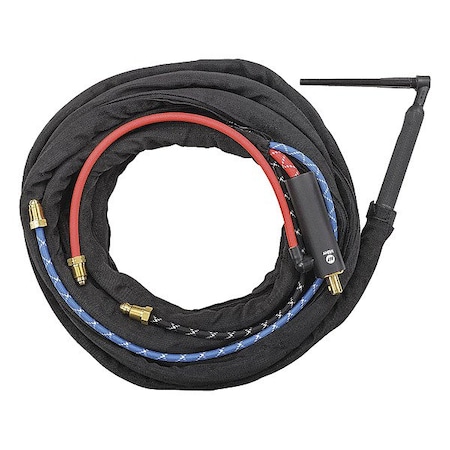
For welding surfaces that will be visible, a handheld TIG torch creates a neater, more aesthetic weld than MIG welding or spot welding. No consumable metal wire is used with a TIG torch. Instead, the arc from a charged tungsten rod melts a filler rod along with the workpiece surface to form the weld. Also unlike MIG welding, TIG torches generate little to no sparking, spatter, smoke, or fume generation. A feature shared by both TIG welding and MIG welding is the shielding gas (usually argon) dispensed by the torch, keeping contaminants from the weld. TIG torches may vary by length of cable and output range (in amps), among other considerations. Note: TIG welding is sometimes called gas tungsten arc welding (GTAW) or heli-arc welding. Lastly, all welding torches, including a TIG torch, require certain accessories, so be sure to check out our welding tips, and welding nozzles.
Frequently Asked Questions
TIG torches discharge an electrical arc between a tungsten electrode and the metal being welded. This concentrated arc melts the metal without spatter, creating strong, precise, and aesthetically pleasing welds.
When choosing a TIG torch, consider the amperage rating, which determines its power; the torch body style, which affects ergonomics and maneuverability; and the type of electrode holder, such as collet or lever-style, based on preference and application needs.
For safe TIG welding, wear proper protective gear such as welding gloves, helmet, and clothing to shield against intense heat, UV rays, and sparks. Ensure the workspace is well-ventilated to prevent fume inhalation.
TIG welding involves various techniques to achieve optimal results. The 'dabbing' technique involves repeatedly tapping the electrode on the weld puddle, while the 'walking the cup' technique involves moving the torch in small circles to evenly distribute the weld.