
Predictive Maintenance in Manufacturing

Predictive Maintenance in Manufacturing
How effective is your current maintenance program? If you’re still relying on fixed schedules, equipment manuals, or past experience to guide maintenance decisions, it might be time for a change. While these approaches seem reliable, they often overlook how equipment is actually used in real-world conditions.
Without access to real-time data, maintenance efforts can become inefficient, leading to unnecessary servicing, increased wear on assets, and costly downtime. In fact, poor maintenance strategies can reduce overall equipment productivity and contribute to billions of dollars in losses each year. As manufacturers look to improve efficiency and reliability, many are turning to predictive maintenance as a more data-driven solution.
What is Predictive Maintenance?
Predictive maintenance is a proactive strategy that uses real-time data and advanced analytics to determine when equipment should be serviced. Rather than relying on schedules or waiting for failures, predictive maintenance monitors the actual condition of machines to identify potential issues early.
This approach is powered by technologies like the Internet of Things (IoT), artificial intelligence (AI), and machine learning, making AI for predictive maintenance in manufacturing a key driver of innovation. Equipment with sensors can communicate performance data to predictive maintenance systems and operators.
This enables organizations to detect anomalies, assess equipment health, estimate remaining useful life, and predict failures before they occur. The goal is to maximize asset lifespan while minimizing both planned and unplanned downtime.
Source: Deloitte
Predictive Maintenance vs. Preventive Maintenance
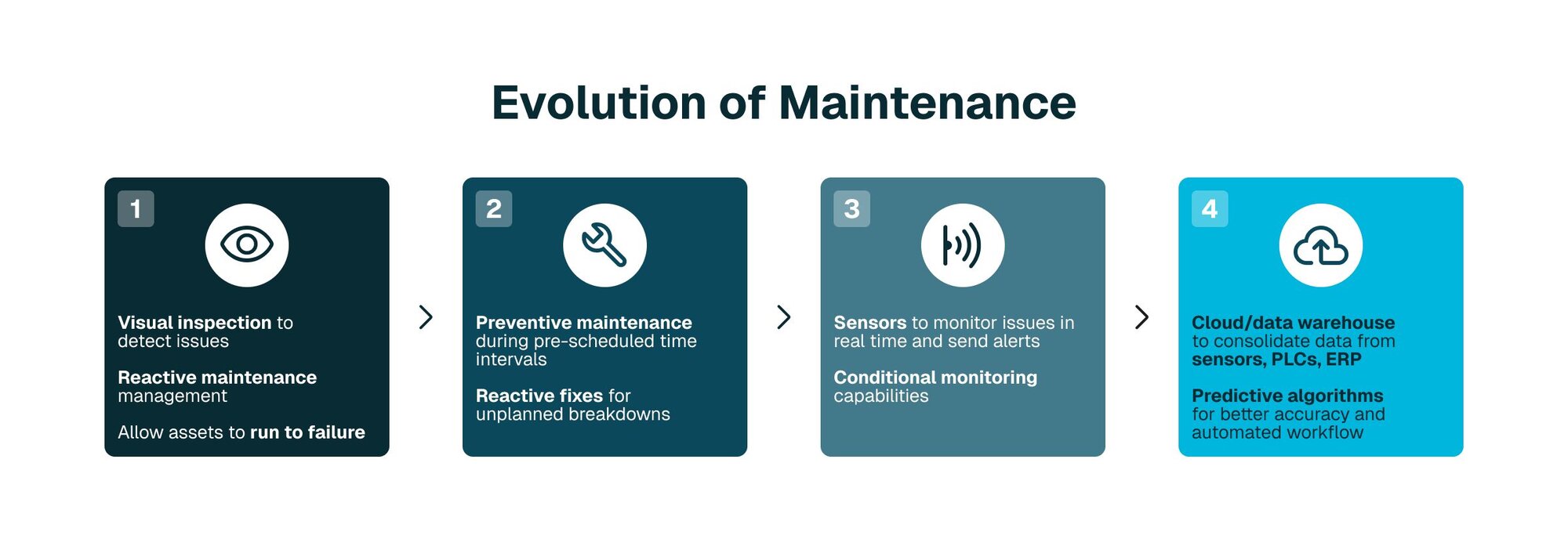
Manufacturers typically use three main maintenance strategies: reactive, preventive, and predictive. Reactive maintenance addresses issues only after equipment fails, often resulting in unexpected downtime. Preventive maintenance follows a fixed schedule based on time or usage estimates, regardless of the equipment’s actual condition.
Predictive maintenance improves on these approaches by using real-time data to guide decisions. Instead of assuming when maintenance is needed, predictive maintenance identifies the optimal time based on equipment performance. This reduces unnecessary maintenance while helping prevent major failures.
These predictive maintenance advantages help organizations lower costs, improve reliability, and make better use of resources.
How Does Predictive Maintenance Work?
Predictive maintenance relies on various technologies, including the Internet of Things (IoT), predictive analytics, and artificial intelligence (AI). Connected sensors gather data from assets such as machinery and equipment. This is collected in an AI-enabled enterprise asset management (EAM) or computerized maintenance management system (CMMS). AI and machine learning are used to analyze the data in real time to build a picture of the current condition of the equipment. If any potential defect is identified, an alert is triggered and delivered to the maintenance team.
In more advanced environments, ERP for predictive maintenance in manufacturing plants can integrate this data into broader business processes like inventory, procurement, and workforce planning.
As well as providing defect warnings, advances in machine learning algorithms enable predictive maintenance solutions to make predictions about the future condition of equipment. These can be used to drive greater efficiency in maintenance-related workflows and processes such as just-in-time work order scheduling and labor and parts supply chains.
Benefits of Predictive Maintenance
The benefits of predictive maintenance in manufacturing extend across both operations and strategy. By identifying issues early, organizations can reduce unplanned downtime and improve equipment reliability, leading to more consistent production.
Additional benefits include:
- Improved safety, health, and environment (SHE) compliance
- More efficient use of maintenance resources
- Better planning for labor and spare parts
- Increased visibility into equipment performance
- Stronger alignment between operational performance and business goals
By shifting from reactive or schedule-based maintenance to a data-driven approach, organizations can make more informed decisions and improve overall efficiency.
Predictive Maintenance Challenges
Despite its advantages, predictive maintenance can be challenging to implement. One of the main barriers is the initial cost, which may include investing in sensors, data infrastructure, and advanced analytics tools. Many facilities also need to upgrade or integrate legacy systems, which can add complexity.
Workforce training is another key challenge. Employees must learn how to use new tools and interpret data effectively. In addition, predictive maintenance requires access to large volumes of high-quality historical and real-time data. Without sufficient data, predictions may be less accurate.
Successfully implementing predictive maintenance often requires a strategic approach, including clear goals, stakeholder alignment, and a strong understanding of costs versus benefits.
Integration with Existing Systems
One of the strengths of predictive maintenance is its ability to work alongside existing systems such as MES, SCADA, and ERP platforms. Most manufacturers can’t replace their entire infrastructure, so integration is critical.
Older machines can often be retrofitted with external sensors to enable real-time monitoring.
Data from these sensors can be routed through gateways into existing systems, providing visibility into equipment performance and triggering actions like maintenance scheduling or parts reordering.
Many organizations are also adopting edge computing, which processes data locally and allows for faster response times, even when cloud connectivity is limited. This approach helps minimize disruptions and ensures that predictive maintenance can be implemented without overhauling existing operations.
Key Takeaways
Predictive maintenance represents a shift toward more intelligent, data-driven manufacturing operations. By using real-time data and advanced analytics, manufacturers can move beyond reactive and schedule-based approaches to maintenance. This enables more accurate decision-making, reduces downtime, and extends the life of critical assets.
Product Compliance and Suitability
The statements contained in this guide are intended for general informational purposes only. Such statements do not constitute a product recommendation or representation as to the appropriateness, accuracy, completeness, correctness, or currentness of the information provided. Information provided in this guide does not replace the use by you of any manufacturer instructions, technical product manual, or other professional resource or adviser available to you. Always read, understand, and follow all manufacturer instructions. Portions of this article were generated in part by ChatGPT, and edited by a member of the Zoro team.
Sources
https://www.sciencedirect.com/science/article/pii/S1755581724000221#sec0030
https://www.ibm.com/think/topics/what-is-preventive-maintenance
https://www.ibm.com/think/topics/enterprise-asset-management
https://upkeep.com/learning/predictive-maintenance-in-manufacturing/
https://www.augury.com/blog/asset-care/predictive-maintenance-in-manufacturing/
https://llumin.com/blog/predictive-maintenance-in-manufacturing-llu/
